
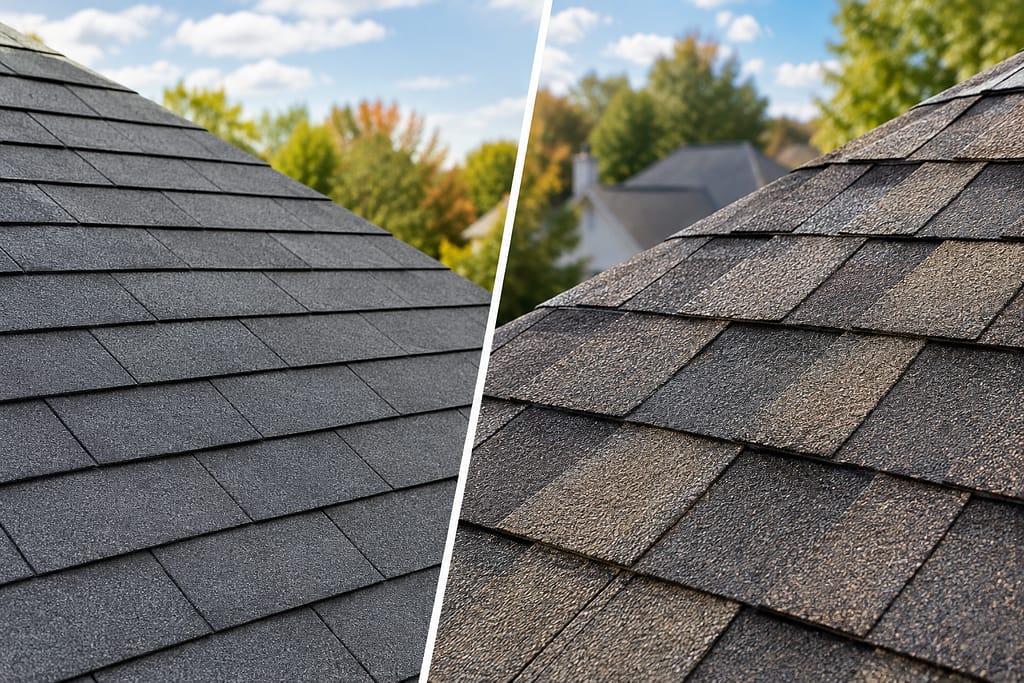
If you’ve ever gotten a roofing estimate, you’ve probably seen two shingle types listed: 3-tab and architectural. They look similar from the street, and the price difference can seem small on paper. But the two perform very differently over time, especially in Central Ohio, where roofs deal with freeze-thaw cycles, summer heat, heavy rain, and the occasional severe storm.
Here’s an honest breakdown of both, so you can decide what makes sense for your home.
What Is a 3-Tab Shingle?
A 3-tab shingle is the traditional, entry-level asphalt shingle. It’s a single layer of material cut into three evenly sized tabs, which gives the roof a flat, uniform look with visible, regular lines.
The basics:
- Single-layer construction
- Flat, uniform appearance
- Lighter weight
- Lowest upfront cost
- Typically rated for around 15 to 20 years in real-world conditions
3-tab shingles were the standard for decades, and plenty of homes in Dublin, Hilliard, Grove City, and Pickerington still have them. They’ve become less common on new installs, and many manufacturers have scaled back or discontinued their 3-tab lines.
What Is an Architectural Shingle?
Architectural shingles (also called dimensional or laminate shingles) are built from multiple layers laminated together. The layering creates a thicker shingle with a textured, dimensional look. Instead of repeating tabs, the cut pattern is varied, which gives the roof depth and shadow lines.
The basics:
- Multi-layer laminated construction
- Thicker, heavier, more dimensional appearance
- Higher wind ratings
- Moderately higher upfront cost
- Typically rated for 25 to 30 years or more, with longer manufacturer warranties
Side-by-Side Comparison
| Feature | 3-Tab Shingles | Architectural Shingles |
|---|---|---|
| Construction | Single layer | Multi-layer laminate |
| Appearance | Flat, uniform | Textured, dimensional |
| Typical lifespan | 15–20 years | 25–30+ years |
| Wind resistance | Lower (often rated around 60 mph) | Higher (often 110–130 mph with proper installation) |
| Weight | Lighter | Heavier |
| Warranty options | Shorter, more limited | Longer, often with enhanced coverage |
| Upfront cost | Lowest | Moderately higher |
| Impact-resistant options | Rare | Widely available |
| Curb appeal and resale | Basic | Stronger |
Exact ratings and warranty terms vary by manufacturer and product line, so always check the specifics of what’s being quoted to you.
Durability and Weather Performance
This is where the two types separate the most.
Because architectural shingles are thicker and heavier, they hold up better against the things Ohio roofs deal with year-round: wind gusts, hail, temperature swings, and heavy rain. The extra mass also helps them lay flatter and resist curling and cupping as they age.
3-tab shingles are thinner, so they’re more prone to wind lift, cracking, and premature wear. When they fail, it often shows up as missing tabs after a windy day or granule loss that makes the roof look worn well before its time.
If you’re looking at impact-resistant (Class 4) shingles, which can also help with insurance premiums on some policies, those are almost exclusively available in architectural lines.
Appearance and Curb Appeal
A 3-tab roof has a clean but flat look. An architectural roof has more visual depth, with shadow lines that mimic the look of wood shake or slate at a much lower cost.
If you’re planning to sell in the next several years, this matters. Buyers and appraisers tend to notice roof quality, and a dimensional shingle in a current color usually reads as a more updated, better-maintained home.
Cost: Looking Past the Sticker Price
Architectural shingles cost more upfront. For most homes, the difference in total project cost is modest compared to the whole job, because labor, tear-off, underlayment, flashing, and ventilation make up a big share of the price regardless of which shingle you choose.
Here’s the part people miss: you pay for those labor and prep costs again when the roof is replaced. A 3-tab roof that lasts 15 to 20 years versus an architectural roof that lasts 25 to 30 means you may replace the cheaper roof a full cycle sooner. Over the life of your home, the architectural shingle usually comes out ahead on cost per year.
When Might 3-Tab Still Make Sense?
To be fair, there are situations where 3-tab is a reasonable call:
- A tight budget on a home you plan to sell soon
- A secondary structure like a shed or detached garage
- A rental or flip where short-term cost is the priority
Even then, availability is shrinking, and many homeowners find the architectural upgrade is worth the added cost.
Don’t Skip the Rest of the Roof System
The shingle gets the attention, but it’s only one part of the system. Underlayment, flashing, ice and water shield, and attic ventilation all affect how long your roof lasts. A great shingle on poor ventilation or a worn-out deck won’t reach its rated lifespan. When you compare quotes, make sure you’re comparing the full scope, not just the shingle name.
How to Know What You Have Now
Not sure which type is on your roof? A few quick clues:
- Look at the tab pattern. Evenly spaced, identical tabs with clean cutouts are a sign of 3-tab. A random, layered, textured look points to architectural.
- Check the thickness at the edge. Architectural shingles are noticeably thicker.
- Look at the age. If your roof is 20 years old or more, there’s a good chance it’s 3-tab.
If you’d rather not climb up there (and we don’t recommend it), a professional inspection can tell you the shingle type, the condition, and whether there’s hidden damage you can’t see from the ground.
The Bottom Line
For most Central Ohio homeowners, architectural shingles are the better long-term investment: stronger against wind and weather, longer lasting, better looking, and available in impact-resistant options. 3-tab shingles still have a place in a few situations, but they’re increasingly the exception rather than the rule.
Thinking about a roof replacement, or just want to know where your current roof stands? Roof Ohio offers honest, no-pressure inspections for homeowners across Dublin, Powell, Hilliard, Gahanna, New Albany, Pickerington, Grove City, Canal Winchester, and Granville. We’ll tell you what you have, what shape it’s in, and what your real options are.