
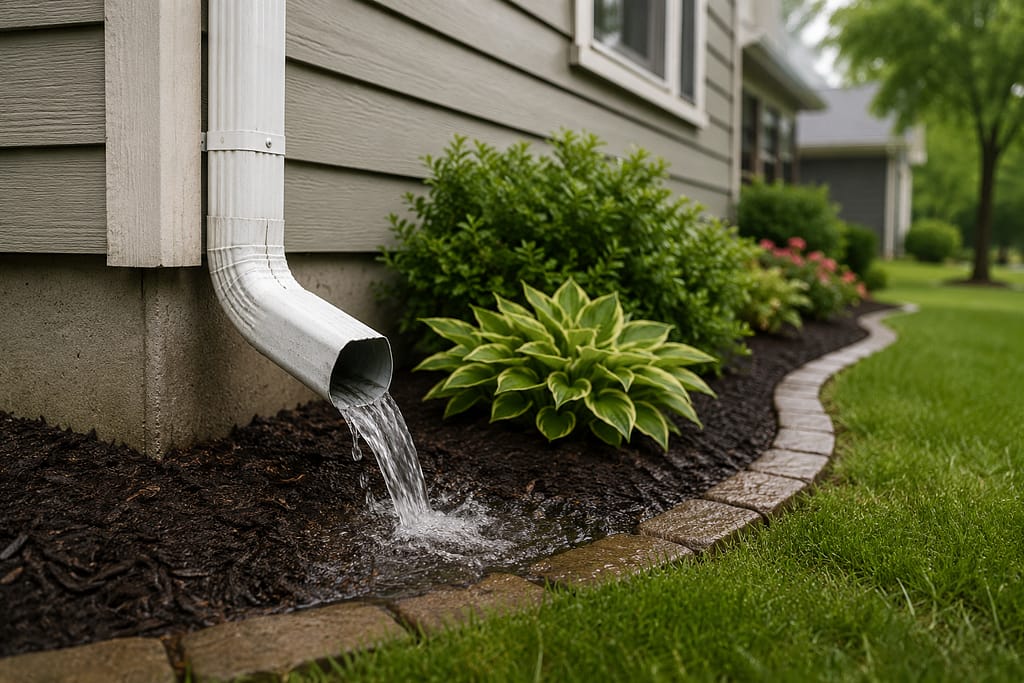
They’re easy to ignore — those metal tubes running down the side of your house. But downspouts are one of the hardest-working parts of your home’s exterior, and neglecting them can lead to some of the most expensive repairs a homeowner faces. Here’s what you need to know.
What Downspouts Actually Do
Downspouts are the vertical pipes that carry rainwater from your gutters down to ground level and away from your foundation. During a single inch of rain, a 1,500-square-foot roof sheds roughly 900 gallons of water. Without gutters and downspouts to control that flow, all of it would pour straight off your eaves, saturate the soil around your foundation, and find its way into your basement or crawl space.
In short: downspouts exist to protect your foundation. That makes them one of the most consequential — and most overlooked — systems on your property.
How Many Do You Need?
A common rule of thumb is one downspout for every 20–30 linear feet of gutter, and one for every 600–800 square feet of roof area draining to a single gutter run. Larger roof sections, steeply pitched roofs, and regions with heavy rainfall may need more.
If your gutters overflow during a moderate rain even after cleaning, that’s often a sign you don’t have enough downspouts — or that the ones you have are undersized.
Where the Water Goes Matters
A downspout that dumps water right at your foundation is only marginally better than no downspout at all. The discharge point is just as important as the pipe itself.
Splash blocks are the concrete or plastic pads placed at the base of a downspout. They’re a minimum — not a solution. Water should travel at least 6 feet away from your foundation, and the ground should slope away from the house (grading) to keep it moving in the right direction.
Downspout extensions are simple flexible or rigid tubes that attach to the bottom of your downspout and redirect water farther out into the yard. They’re inexpensive and make a real difference.
Underground drainage systems pipe the water away from the house entirely, discharging into a dry well, rain garden, or the street. This is the gold standard for problem areas and costs more but solves the issue permanently.
Signs Your Downspouts Are Failing
Watch for these red flags:
- Water stains or efflorescence on your foundation walls — mineral deposits that indicate water is consistently pressing against the concrete
- Gutters overflowing at or near a downspout — usually means a clog
- Pooling water at the base of the downspout after rain
- Basement dampness or seepage along the walls, especially after heavy rain
- Erosion or bare patches in the soil or lawn directly below the downspout outlet
- Rust streaks or visible holes in the downspout itself
- Separated joints where sections of the downspout have pulled apart
Any of these warrants a closer look before the next rainy season.
Cleaning and Maintenance
Clogged downspouts are the most common downspout problem, and the fix is usually straightforward.
How often to clean: At a minimum, once in late fall after leaves have dropped and once in spring. If you have overhanging trees, aim for quarterly.
How to clear a clog:
- Disconnect the downspout from the gutter at the top.
- Try flushing from the bottom up with a garden hose. Pressure often dislodges soft clogs.
- For stubborn blockages, use a plumber’s snake fed from the top.
- A pressure washer with a gutter-cleaning attachment works well for thorough cleaning.
Downspout strainers (also called gutter guards at the downspout outlet) can reduce how often you need to clean. They’re not foolproof, but they cut down significantly on debris entering the pipe.
Common Downspout Problems and Fixes
Leaking joints: Sections of downspout are joined with overlapping slip connectors. Over time, caulk or sealant fails. Clean the joint, dry it thoroughly, and reseal with gutter sealant or silicone caulk.
Loose or missing straps: Downspouts are held to the house with metal brackets called straps or hangers. If a section has pulled away from the wall, re-fasten it with new screws into solid wood or masonry anchors if going into brick or stucco.
Dents and crimps: A dented downspout can restrict flow and catch debris. Mild dents can sometimes be worked out by hand. Severely crimped sections should be replaced — individual sections are inexpensive.
Rusted or corroded sections: Galvanized steel downspouts eventually rust. Patch small rust spots with roofing cement, or replace the affected section. If your downspouts are older than 20 years and showing widespread rust, it’s worth replacing the whole run. Aluminum doesn’t rust and is a popular upgrade.
Material Options
- Aluminum — The most common choice today. Lightweight, rust-proof, and available in seamless or sectional form. Typically lasts 20–30 years.
- Galvanized steel — Heavier and stronger, but will rust over time, especially in humid climates.
- Vinyl (PVC) — Inexpensive and easy to work with, but becomes brittle in cold climates and can crack.
- Copper — Beautiful, extremely durable, and naturally antimicrobial. Also significantly more expensive. Often used on historic homes or high-end builds.
For most homeowners, aluminum is the right call: it lasts, it’s affordable, and it won’t leave rust streaks on your siding.
When to Call a Professional
DIY maintenance handles most downspout issues, but call a pro when:
- You’re seeing persistent basement water intrusion — a waterproofing contractor or drainage specialist should assess the full drainage picture
- You need to add downspouts or reroute discharge underground
- Your fascia board (the wood behind the gutter) is rotting — this is a sign of long-term overflow and needs carpentry repair before reroofing
- You’re on a very steep roof or multi-story home where ladder safety becomes a real concern
The Bottom Line
Downspouts are unglamorous, but they’re load-bearing in the financial sense. A $5 tube of gutter sealant and 30 minutes of attention twice a year can prevent thousands of dollars in foundation repair, basement waterproofing, or landscaping restoration.
Take a walk around your house the next time it rains and watch where the water goes. That five-minute observation might be the most valuable home inspection you ever do.