Most Central Ohio homeowners don’t spend a lot of time thinking about their roof until something goes wrong. And by the time something goes wrong, it’s usually already been wrong for a while. One of the most telling warning signs on any aging or storm-damaged roof is a pattern called zippering.
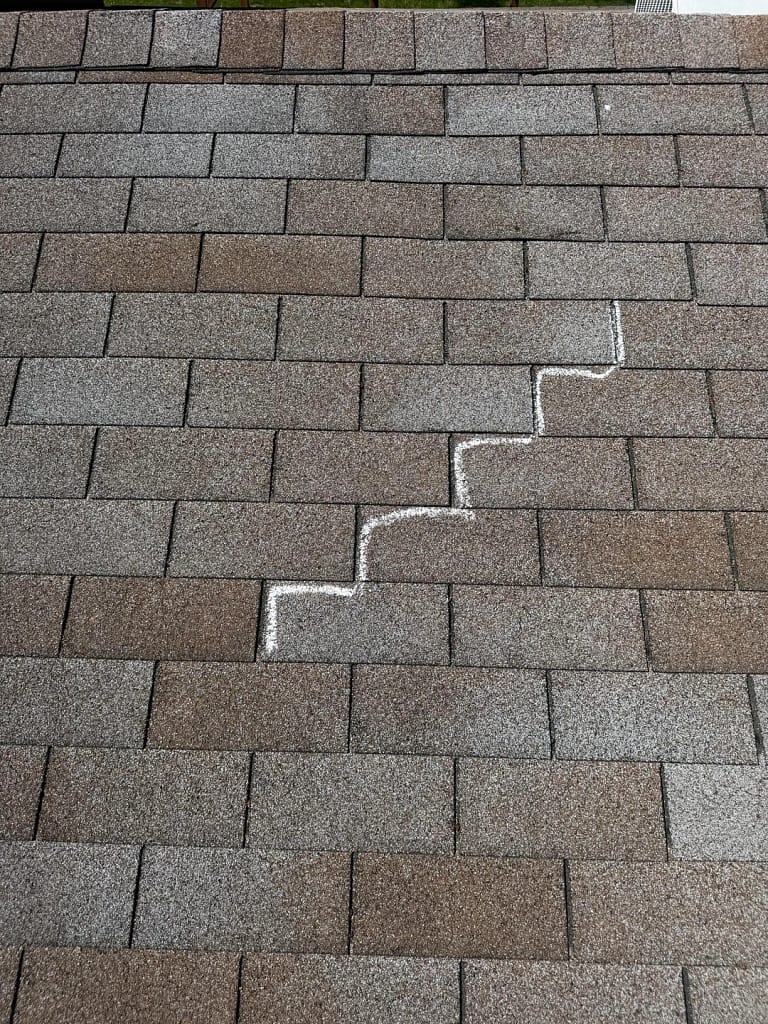
If you’ve ever seen a row of shingles that look like they’ve cracked or split in a clean, almost perfectly straight line across your roof, you’ve seen zippering. It looks like someone unzipped your roof from the outside. And if you’re seeing it, there’s a lot more going on beneath the surface than a few cracked shingles.
Here’s what you need to know.
What Is Zippering?
Zippering is a term used in the roofing industry to describe a specific failure pattern where shingles crack, split, or separate along a horizontal or vertical line — often following the butt edge (the exposed bottom of each shingle course) or the seam between tab rows. The result is a chain-reaction of damage that runs across your roof like a zipper being pulled open.
It’s not random damage. That’s actually what makes zippering distinctive. Hail tends to create scattered bruising across a roof’s surface. Wind creates lifted, curled, or missing shingles. But zippering creates a linear pattern — usually along an entire course of shingles — that reflects a specific type of stress or structural vulnerability.
The problem is that because zippering can look subtle from the ground, many homeowners dismiss it as cosmetic wear. It’s not.
What Causes Zippering?
There are several root causes, and they’re not mutually exclusive. In Ohio’s climate, a combination of factors is common.
Age and Brittleness
Asphalt shingles have a lifespan — typically 20 to 30 years for standard 3-tab shingles and 25 to 50 years for architectural shingles, depending on quality and installation. As shingles age, the asphalt becomes brittle and loses its flexibility. When that happens, the shingle can no longer absorb impact or accommodate the normal expansion and contraction that comes with temperature changes. The result? Shingles crack — and they tend to crack in the weakest spots, which are often consistent from one shingle to the next along the same course.
Thermal Cycling
Ohio’s weather is particularly hard on roofing systems. We’re talking about summers that push into the 90s and winters that drop well below freezing, often within the same month in spring and fall. Every time a shingle heats up, it expands. Every time it cools, it contracts. Over hundreds of cycles per year, that constant movement stresses the shingle along its weakest points — and those weak points often align in a row, producing the zipper effect.
This is one of the reasons Class 4 impact-resistant shingles with a UL 2218 rating hold up better over time. They’re engineered with more flexible polymers that accommodate thermal movement far better than standard asphalt shingles.
Hail Impact
Here’s something a lot of Central Ohio homeowners don’t realize: hail damage doesn’t always show up immediately. A significant storm — even one that doesn’t leave obvious dents on your gutters or siding — can crack the structural integrity of a shingle beneath the surface. The granule coating may still look intact, but the mat underneath has fractured.
Over time, those hairline fractures give way to visible splits — and because hailstones typically hit in a directional pattern driven by wind, the fractures tend to line up. That’s zippering from delayed hail damage. And it matters a great deal when it comes to your insurance claim, because this type of damage is usually covered under your homeowner’s policy — if you can document it properly and within your policy’s claim window.
Poor Installation
Over-driven nails are one of the most common installation mistakes in the industry, and they’re a leading contributor to early zippering. When a nail is driven too deep into a shingle, it creates a stress point in the shingle mat. That stress point can eventually lead to a crack that travels across the shingle — and when the same mistake is repeated shingle after shingle, the cracks line up in a row. Zipper.
This is especially common with work done by storm chasers — out-of-state contractors who flood local markets after major weather events, rush through jobs with inexperienced crews, and are long gone by the time the problems show up a few years later.
Improper Ventilation
A poorly ventilated attic traps heat. In the summer, attic temperatures in under-ventilated homes can exceed 150°F. That sustained heat cooks the shingles from below, accelerating brittleness and causing the adhesive strips (the tar strips that seal shingle tabs down) to fail prematurely. Once the adhesive fails, the tab is free to flex with the wind — and that repeated flexing leads to cracking along the shingle’s adhesive line. In course after course, those cracks align. Zipper.
Why Zippering Is a Bigger Problem Than It Looks
When a shingle cracks through, it stops functioning as a water barrier. Water intrusion follows the path of least resistance — which is through the crack, past the underlayment (if it’s compromised too), and into your decking.
Here’s where it gets expensive.
Decking Damage
Once water is getting to your roof decking on a regular basis — even small amounts with each rain — the plywood or OSB begins to soften, delaminate, and rot. Decking replacement adds significant cost to any roofing project and may not be visible or discoverable until the old roof is torn off.
Mold and Mildew
Moisture that penetrates the decking doesn’t stop there. It migrates into the attic insulation, where it creates an ideal environment for mold growth. Mold remediation is expensive, disruptive, and a health concern — especially for families with respiratory sensitivities.
Voided Manufacturer Warranties
Many shingle manufacturers require proper ventilation and underlayment as conditions of their material warranties. If a roof with a zippering problem is inspected and found to have inadequate ventilation or improper installation beneath it, the warranty claim can be denied. You lose the protection you thought you had.
Insurance Claim Complications
If hail or storm damage is the root cause of your zippering, you may have a legitimate insurance claim — but only if it’s filed in time and documented correctly. Most Ohio homeowner’s policies have a statute of limitations on storm damage claims. Waiting until the zippering becomes a visible interior leak is often waiting too long.
A qualified, local roofing contractor who understands insurance claims can help you determine whether your zippering is storm-related, document the cause, and work with your adjuster to ensure you’re not leaving money on the table.
What to Do If You Suspect Zippering
Don’t wait for a leak. By the time water is showing up on your ceiling, the damage has already progressed well beyond the shingles themselves.
Here’s the practical path forward:
1. Get an inspection after any significant storm. Central Ohio gets hit hard in spring and summer — severe thunderstorms, large hail, straight-line winds. After any significant weather event, it’s worth having your roof professionally inspected. A qualified inspector knows what to look for and can identify zippering, bruising, and granule loss that isn’t visible from the street.
2. Don’t climb on the roof yourself. This isn’t just about safety. It’s about documentation. If you’re filing an insurance claim, any disturbance to the existing damage can complicate your adjuster’s evaluation. Let a professional document the condition first.
3. Know your rights under Ohio law. If your roof has sustained damage and your insurer approves a partial replacement, Ohio’s matching standard — Ohio Administrative Code 3901-1-54 — may require your insurer to cover matching materials for undamaged portions of the roof when the original materials are discontinued or no longer match. This matters. A stripe of new shingles running across an aging roof isn’t just an eyesore — it may not fully comply with Ohio’s insurance regulations.
4. Be cautious with out-of-state contractors. After a storm, you’ll see a surge of contractors going door-to-door in Central Ohio neighborhoods. Many are legitimate; some are not. Storm chasers often identify zippering damage and offer fast, low-cost repairs that don’t address the underlying cause — poor ventilation, bad installation, compromised decking. A patch job on a zippering roof is a temporary fix on a permanent problem.
5. Ask about material upgrades. If your current shingles are aging and showing signs of brittleness, now is the time to consider Class 4 impact-resistant shingles. In Ohio, these may qualify you for a discount on your homeowner’s insurance premium, and they dramatically reduce the risk of future zippering caused by hail impact or thermal cycling.
The Bottom Line
Zippering is a signal. It’s your roof telling you that something — age, impact, installation error, ventilation failure — has reached a tipping point. The damage is linear because roofing systems are built in courses, and when one weak point appears, the rest of the course tends to follow.
If you’re in Westerville, Dublin, Powell, Gahanna, New Albany, or anywhere in the greater Columbus area and you’ve noticed what looks like a straight line of cracked or split shingles, don’t wait. The longer zippering is left unaddressed, the more the damage migrates down into the decking, the insulation, and eventually your living space.
The roof’s job is to protect everything underneath it. When it starts unzipping, the clock is ticking.