When homeowners in Westerville, Dublin, or New Albany think about their roof, they picture shingles. Understandable — shingles are what you see from the driveway. But ask any roofer what actually keeps water out of your attic during a February thaw or a July downpour, and you’ll get a different answer: underlayment.
Underlayment is the layer between your roof deck and your shingles, and it’s the part of the roofing system doing the quiet, unglamorous work of stopping leaks. Get it wrong, and even premium shingles won’t save you from water damage. Get it right, and your roof handles everything Central Ohio’s weather throws at it — ice dams in January, wind-driven rain in April, heat dome humidity in August.
Why Underlayment Matters More in Ohio Than Almost Anywhere Else
Ohio doesn’t get one kind of weather — it gets all of them. In a single year, a Central Ohio roof might deal with:
- Sub-zero cold snaps that create ice dams along eaves
- Heavy spring storms with sideways-blowing rain
- Summer heat domes that push attic and deck temperatures well past 150°F
- Freeze-thaw cycles that repeat dozens of times between November and March
That kind of variability is exactly why “just use whatever’s cheapest” is the wrong approach to underlayment. The right choice depends on where on the roof it’s going, how steep the roof is, and what part of the season is doing the most damage where you live.
The Three Main Types of Underlayment
1. Asphalt-Saturated Felt (Traditional “Tar Paper”)
This is the old standby — asphalt felt in 15-lb or 30-lb weights. It’s inexpensive and has decades of track record, but it’s also the least durable option. Felt absorbs moisture, can wrinkle under humidity, tears more easily in wind, and breaks down faster under UV exposure if a roof sits uncovered during a job delay.
Where it still shows up: Budget-conscious re-roofs on simple, low-complexity roof lines. It’s becoming less common as synthetic options have dropped in price.
2. Synthetic Underlayment
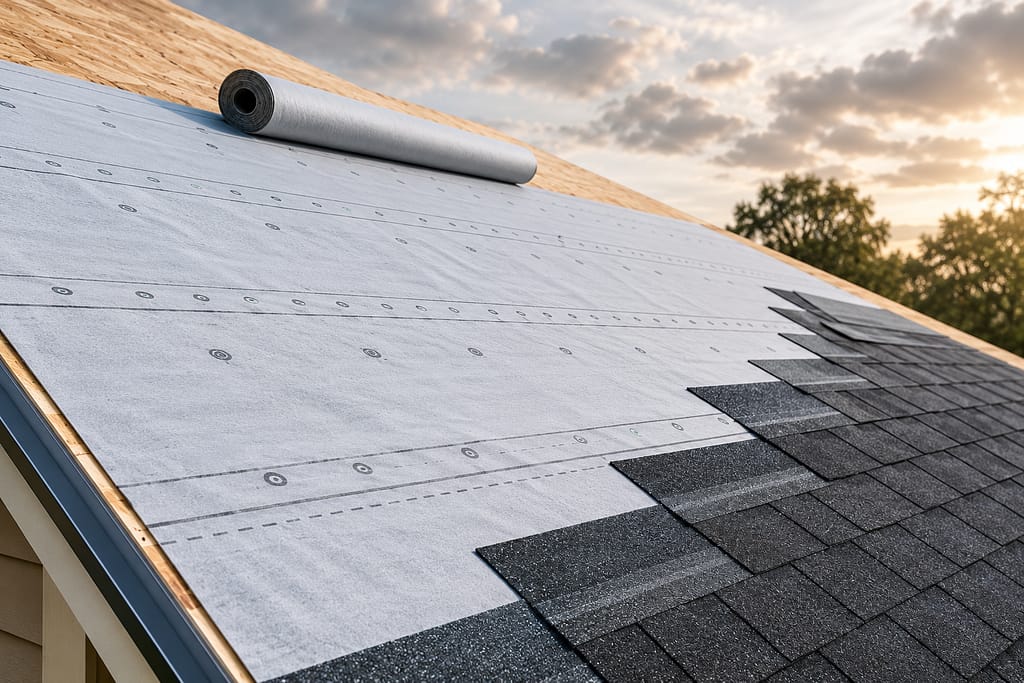
Woven from polypropylene or polyethylene, synthetic underlayment is now the standard choice for most of a roof deck on jobs we do around Franklin, Delaware, and Licking counties. It’s lighter, stronger, and more consistent than felt:
- Doesn’t absorb water or wrinkle
- Far more tear- and puncture-resistant, which matters during installation on breezy days
- Handles UV exposure for weeks if weather delays shingle installation
- More sure footing for crews, which matters for both safety and workmanship
Synthetic underlayment isn’t a luxury upgrade at this point — it’s simply the more durable material for the same or similar cost as high-end felt.
3. Ice and Water Shield (Self-Adhering Membrane)
This is a rubberized asphalt membrane that self-seals around fasteners, and it’s non-negotiable in specific zones of an Ohio roof, regardless of what underlayment covers the rest of the deck. It goes down first, along:
- Eaves — extending at least 24″ past the interior wall line, to protect against ice dam backup
- Valleys — where water volume concentrates and standard underlayment is more likely to fail
- Roof penetrations — chimneys, skylights, and vent stacks, where the deck is already compromised by a cut
Ice dams are a real issue here — not a Northern Michigan problem. When snow melts unevenly off a warmer roof deck and refreezes at a colder overhang, it forms a dam that pushes water backward, under shingles that were never designed to handle standing water. Ice and water shield at the eaves is the single most effective defense against that specific failure mode, and it’s why we treat it as required, not optional, on every roof we install.
How to Actually Decide What Your Roof Needs
Rather than picking a single “best” underlayment, think of it as building a system with the right material in the right place:
Roof slope matters. Lower-slope sections shed water more slowly, which means water sits longer and has more opportunity to find a weak seam. Lower-slope roofs typically need broader ice and water shield coverage, sometimes across the entire deck rather than just the eaves and valleys.
Roof age and complexity matter. A roof with multiple valleys, dormers, or chimneys has more vulnerable transition points than a simple gable roof. More complexity means more linear feet of ice and water shield.
How long the deck will sit exposed matters. If your project has any risk of a multi-day gap between tear-off and shingle installation — common during a busy storm season — synthetic underlayment’s UV resistance becomes a real practical advantage over felt.
Your insurance claim matters. If your roof is being replaced through an insurance claim after storm damage, Ohio’s matching standard under Ohio Administrative Code 3901-1-54 is worth understanding — but underlayment choice is also where corners sometimes get cut in a rushed insurance job. A contractor racing through repairs may use minimal underlayment or skip ice and water shield in areas that need it, since it’s invisible once shingles go down. It’s one more reason to work with a roofer who documents the install, not just the finished look.
A Word on Storm Chasers and Underlayment Shortcuts
Underlayment is one of the easiest places for a fly-by-night contractor to cut corners, because nobody sees it after the job’s done. If a contractor going door-to-door after a storm can’t clearly explain what underlayment they’re using and where, or seems rushed to skip straight to shingles, that’s worth a second opinion. A reputable local roofer will walk you through exactly what’s going under your new roof and why — not just what color shingle you’re picking.
The Bottom Line
Your shingles get the attention, but your underlayment is what actually keeps your home dry through an Ohio winter’s freeze-thaw cycles and a summer’s storm season. The right system isn’t one product — it’s synthetic underlayment across the field of the roof, paired with ice and water shield at every eave, valley, and penetration where water actually concentrates.
If you’re not sure what’s currently under your shingles, or you want a straight answer on what your roof actually needs before your next re-roof, a full roof inspection is the place to start — not a sales estimate. We’ll show you exactly what we find, underlayment included.