
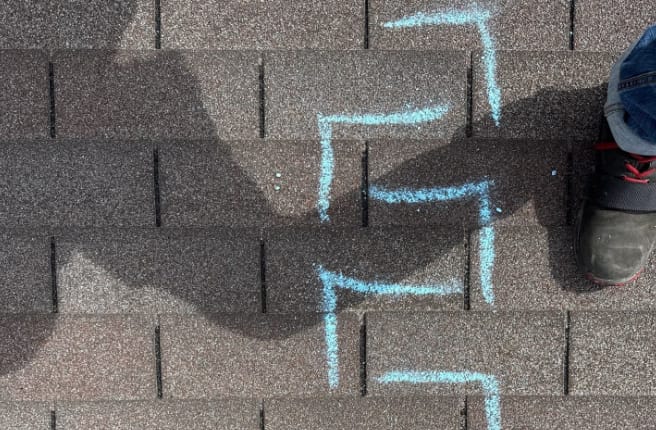
After a major storm rolls through, most homeowners do the same thing: step outside, look up, and breathe a sigh of relief when the roof looks fine. No missing shingles. No obvious holes. No debris dangling from the gutters. Everything looks intact — so everything must be intact, right?
Not necessarily.
Some of the most costly and consequential roof damage is completely invisible from street level. By the time it shows up as a water stain on your ceiling or a sagging section of drywall, the damage has often been festering for months — quietly allowing moisture, mold, and structural deterioration to spread through your home.
Here’s what wind and storms can do to your roof that you simply cannot see from the ground.
1. Lifted and Re-Seated Shingles
High winds don’t always tear shingles completely off a roof. Often, they lift them — breaking the adhesive seal strip that bonds each shingle to the one below it — and then set them back down. From the ground, the shingle appears to be right where it belongs. But the seal is broken.
A re-seated shingle with a broken seal is a shingle that will flutter, curl, and admit water every time it rains. Wind can work its way underneath, and over time the shingle will begin to cup or buckle. Without close inspection, you’d never know the bond was compromised.
2. Granule Loss
Asphalt shingles are coated in granules — the tiny, sandpaper-like particles that give them texture and color. These granules are the shingle’s first line of defense against UV rays and physical weathering. A heavy hailstorm or sustained high winds can knock significant granule coverage loose without cracking or displacing a single shingle.
You might notice granules washing out of your downspouts after a storm, but the bare patches on the shingles themselves are nearly impossible to spot from the ground. Areas with heavy granule loss become vulnerable to accelerated aging and cracking within a year or two, dramatically shortening the life of your roof.
3. Micro-Cracks and Bruising from Hail
A hailstone doesn’t have to be golf-ball sized to damage your roof. Even dime-sized hail, falling at speed, can leave what inspectors call “bruising” — a subtle compression of the asphalt mat beneath the granule layer. The shingle surface may look normal, but the mat underneath has been compromised.
These micro-fractures allow moisture to wick into the shingle body. Over time, they expand and crack, especially during freeze-thaw cycles. A hail-bruised roof can look completely normal for a year before it begins to fail, and by then the insurance claim window may have long closed.
4. Damaged Flashing
Flashing is the thin metal sheeting installed wherever your roof meets a vertical surface — around chimneys, skylights, dormers, vent pipes, and along the edges where a roof valley meets a wall. It’s one of the most leak-prone areas on any roof, and it’s also one of the hardest to inspect from the ground.
Wind can lift, bend, or partially separate flashing from its sealed position. A chimney flashing that has been pried loose by wind may look perfectly normal from 30 feet below, but it’s now channeling water directly into the roof deck every time it rains. Flashing failures are among the most common causes of interior water damage after storms.
5. Cracked or Dislodged Ridge Cap Shingles
The ridge cap runs along the peak of your roof — the very top edge where two slopes meet. It’s the most exposed part of the entire structure and the most susceptible to wind damage. Ridge cap shingles are specially designed for that exposed position, but a strong enough gust can crack, loosen, or partially dislodge them.
Because you’re looking up at a steep angle from the ground, the ridge cap is one of the last things your eye can assess clearly. A cracked ridge cap allows water to penetrate directly at the highest point of your roof, where it can travel along the rafters and spread damage across a wide area.
6. Damaged or Clogged Roof Vents
Storms can crack plastic vent covers, bend metal louvers, or drive debris into soffit and ridge vents. A damaged vent does two things: it allows water intrusion, and it disrupts the ventilation balance in your attic. Poor attic ventilation leads to heat and moisture buildup, which causes sheathing to rot, insulation to degrade, and rafters to weaken over time.
None of this is visible from the ground. But over the course of a few seasons, a single damaged vent can contribute to tens of thousands of dollars in structural damage.
7. Stress on Fasteners and Decking
In extreme wind events, even a roof that holds together completely can sustain stress damage to the underlying structure. Wind uplift places enormous force on the fasteners holding shingles and decking in place. Nails can back out slightly, ring-shank fasteners can work loose, and the decking panels themselves can develop hairline separations at their edges.
None of this is visible without getting on the roof and, in some cases, getting into the attic. But a roof with compromised fastening is a roof that is more vulnerable to the next storm — and that vulnerability compounds with each weather event.
What You Should Do After a Significant Storm
Don’t rely on your own ground-level inspection. It simply cannot tell you what you need to know. Instead:
- Schedule a professional roof inspection within a few weeks of any storm with sustained winds above 50 mph or any hail activity. Roof Ohio offer free post-storm inspections. and 24/7 emergency tarping services
- Check your attic after heavy rain. Bring a flashlight and look for water staining on the sheathing, wet insulation, or daylight coming through the roof deck.
- Document everything. If you do have a professional inspection done, ask for a written report with photographs. This is critical if you need to file a homeowner’s insurance claim.
- Don’t wait for a leak. By the time water appears inside your home, the damage is already significant. A proactive inspection is always cheaper than reactive repair.
The Bottom Line
Your roof is doing a difficult job in difficult conditions, and the damage it sustains isn’t always dramatic or visible. Wind and storms are patient — they create small vulnerabilities that grow slowly into expensive problems. A professional inspection after a significant storm is insurance against the kind of hidden damage that, left unaddressed, can cause many more issues down the road.
When in doubt, get someone up there. What you can’t see from the ground is exactly what matters most.