Most homeowners never think about what’s happening above their ceiling — until it’s far too late and far too expensive.
Your roof is your home’s first and most important line of defense against the elements. But even the finest shingles and most skilled installation can be undone by a single, often-overlooked factor: what’s happening in the attic space just beneath them. Insufficient roof ventilation is one of the most common — and most costly — mistakes in residential construction and home maintenance, quietly shaving years off an otherwise healthy roof.
Why Roof Ventilation Matters More Than You Think
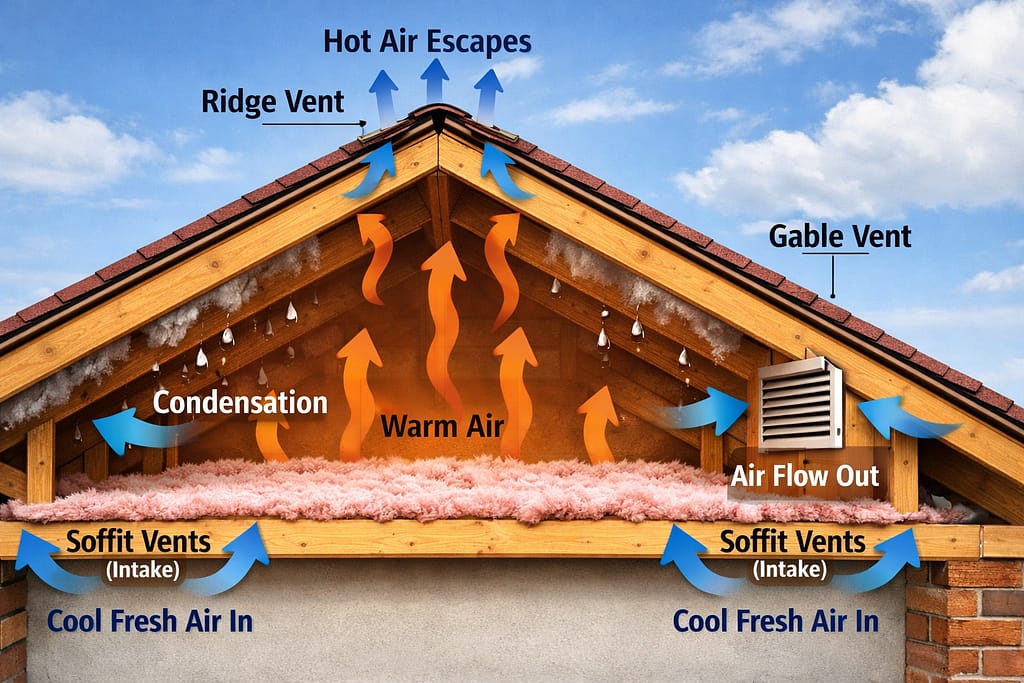
A properly ventilated roof operates on a simple principle: cool, fresh air enters through intake vents at the soffits (the underside of your roof’s overhang), travels across the underside of the roof deck, and exits through exhaust vents near the ridge. This continuous airflow does two critical jobs — it regulates temperature in summer and controls moisture in winter.
When that airflow is blocked, restricted, or simply absent, you create a closed, stagnant environment where heat and humidity have nowhere to go. The roof doesn’t fail all at once. It deteriorates, slowly and invisibly, until one day you’re looking at a repair bill that could have been avoided for the cost of a few vents.
“A roof with poor ventilation isn’t just uncomfortable — it’s actively consuming itself from the inside out.”
The Summer Heat Trap
On a hot summer day, an unventilated or under-ventilated attic can reach temperatures of 150°F (65°C) or higher. That’s not just uncomfortable — it’s structurally destructive.
Shingle Deterioration
Asphalt shingles are rated for a certain number of years under normal conditions. “Normal” assumes that heat from the sun dissipates through the roof system. When excessive heat builds up and radiates back up from a superheated attic, shingles experience what manufacturers call “thermal shock” — repeated cycles of extreme expansion and contraction that cause them to curl, crack, blister, and lose their protective granules far ahead of schedule. A 30-year shingle in a poorly ventilated home may only last 15 to 20 years.
Roof Deck Damage
The plywood or OSB (oriented strand board) sheathing beneath your shingles is equally vulnerable. Sustained extreme heat causes this material to warp, delaminate, and lose its structural integrity. Once the deck is compromised, shingles above it can buckle, and the roof’s ability to shed water is fundamentally weakened.
150° peak attic temp: Unventilated attics on hot days, vs. ~90°F outdoors
50% lifespan loss: Shingles may fail up to half as fast in chronically overheated attics
40% energy increase: Cooling costs can spike when attic heat radiates into living spaces
The Winter Moisture Problem
Summer heat is only half the story. In winter, inadequate ventilation creates a different but equally damaging scenario. Warm, moisture-laden air from your living spaces rises into the attic. Without ventilation to flush it out, that moisture condenses on the cold roof deck and structural members — exactly like a cold glass “sweating” on a humid day.
Rot and Structural Decay
Repeated condensation cycles introduce persistent moisture to wood rafters, trusses, and sheathing. Wood that is repeatedly wetted and dried without ever fully drying out becomes a breeding ground for wood rot fungi. What begins as a dark stain can, over several seasons, progress into soft, structurally useless timber. Replacing rotted rafters and decking is an expensive, labor-intensive project that could have been entirely prevented.
Mold and Air Quality
Mold thrives in warm, damp, dark environments — a description that fits a moisture-laden attic almost perfectly. Once mold establishes itself in roof framing, it can spread to insulation, affect indoor air quality, and in some jurisdictions, trigger disclosure requirements and tank a home’s resale value. Remediation is costly; prevention is cheap.
Ice Dams in Cold Climates
Homeowners in northern climates face another winter hazard directly tied to poor ventilation: ice dams. When attic heat (due to insufficient cold-air ventilation) warms the roof deck unevenly, snow on the warmer upper sections melts and runs down toward the cold eaves, where it refreezes into a solid ridge of ice. Water backs up behind this dam, works under shingles, and leaks into the home. The resulting interior water damage — to ceilings, walls, insulation, and finishes — is often more expensive to fix than the roof itself.
Warning Signs of Poor Roof Ventilation
- Shingles that are curling, blistering, or losing granules prematurely
- Ice dams forming along the roofline in winter
- Noticeably hot upper floors or high summer cooling bills
- Frost or condensation visible on attic framing in cold weather
- A musty or damp smell coming from the attic space
- Rust on metal components inside the attic (nails, HVAC supports)
- Insulation that appears wet, compressed, or discolored
How the Two Seasons Compound Each Other
What makes poor ventilation so insidious is that it doesn’t just cause isolated problems — summer and winter damage compound over time. Sheathing weakened by summer heat absorbs moisture more readily in winter. Wood that has begun to rot is more susceptible to further deterioration under heat stress. Each season leaves the roof slightly worse off than the last, and the damage accelerates.
Summer: Superheated attic air degrades shingles and dries out deck adhesives, making wood porous and brittle.
Winter: Moisture condenses on weakened, porous wood — accelerating rot, mold growth, and ice dam formation.
Spring: Freeze-thaw cycles exploit any water trapped beneath compromised shingles, widening cracks and gaps.
Fall: Debris accumulates in blocked soffit vents, worsening restriction before the harsh winter season begins.
What Proper Ventilation Looks Like
The industry standard, as defined by most building codes, calls for a minimum of 1 square foot of net free ventilation area for every 150 square feet of attic floor space — ideally split evenly between intake (soffit) and exhaust (ridge or roof) vents. This 1:150 ratio ensures a consistent, balanced airflow from low to high.
However, the right system depends heavily on your specific roof design, climate zone, and whether your attic is insulated at the rafters or at the ceiling (the two approaches — ventilated and “hot roof” assemblies — have fundamentally different requirements). A roofing professional can assess your home’s specific needs and identify whether your current ventilation is adequate.
✦ ✦ ✦
The Financial Reality
If the structural damage isn’t persuasive enough, consider the economics. A standard asphalt roof replacement runs anywhere from $8,000 to $25,000 or more depending on the size and complexity of your home. Adding a complete ventilation system — ridge vents, soffit vents, and baffles — typically costs between $300 and $1,500, depending on the scope of the work. The return on that investment, measured in roof lifespan alone, is extraordinary.
Beyond the roof itself, improved ventilation reduces attic temperatures that radiate heat into living spaces, which can meaningfully lower summer air conditioning costs. In cold climates, eliminating ice dams protects gutters, fascia, soffits, and interior finishes that would otherwise require expensive seasonal repairs.
What to Do Next
- Schedule a professional attic inspection, particularly before winter or after a hot summer season.
- Check that soffit vents are not blocked by insulation — baffles should keep a clear channel along the roof deck.
- Ensure your attic has both intake vents (low) and exhaust vents (high) for balanced airflow.
- Calculate your attic square footage and verify you meet the 1:150 ventilation ratio.
- If re-roofing, always address ventilation at the same time — it’s far more cost-effective than a second mobilization later.
- In cold climates, check for ice dam history and add ventilation or air-sealing as appropriate.
A Final Word
Your roof is one of the most significant investments in your home, and ventilation is the quiet, unglamorous system that protects it. It gets no attention when it’s working and enormous, expensive attention when it’s not. The good news is that poor ventilation is one of the most correctable roofing problems there is — but only if you address it before it has spent years doing its slow, invisible damage.
Don’t wait for a leak, a sagging deck, or a mold remediation bill to start thinking about airflow. The roof over your head will last far longer — and cost far less — with a little more of it.
This article is intended for general educational purposes. For assessment of your specific roof and ventilation needs, consult a licensed roofing contractor or building professional in your area.