
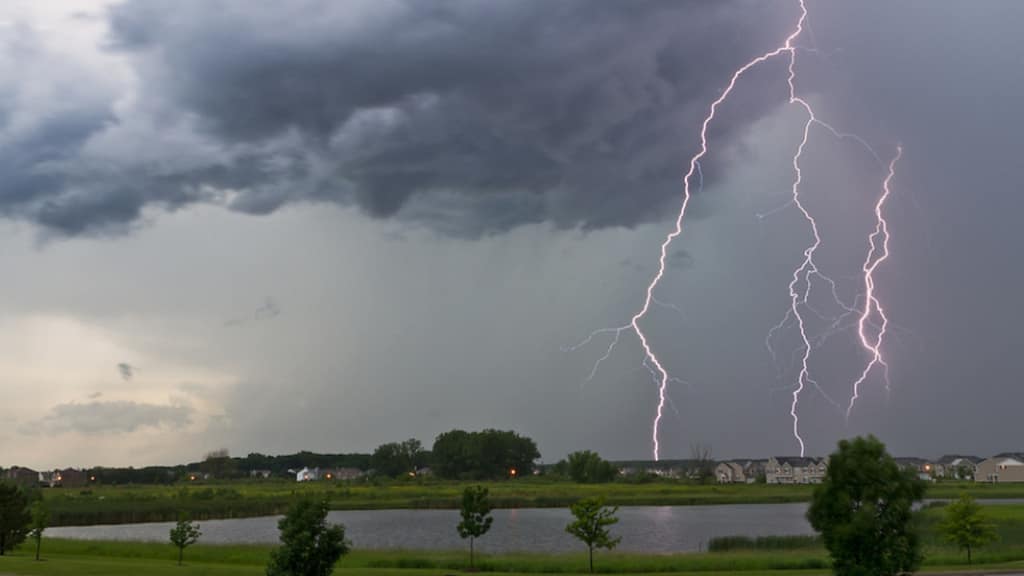
If you live anywhere from Westerville to Dublin, Powell to New Albany, Hilliard to Gahanna, you know Central Ohio storms don’t mess around. High winds, marble-sized hail, sideways rain — a bad night can leave your roof, siding, and gutters with damage you won’t notice just glancing up from the driveway. Here’s a simple walkthrough of what to check the morning after, and why it matters more than you might think.
1. Start With a Ground-Level Walkaround
You don’t need a ladder to catch the first warning signs. Walk the perimeter of your house and look for:
- Granules in your gutters or downspouts. Asphalt shingles shed their protective granule coating when hit by hail or heavy wind-driven rain. A little is normal over time. A pile that looks like coarse sand after one storm is not.
- Dented or dinged gutters, downspouts, and window screens. Soft metal shows hail impact easily. If your gutters look like they went a round with a golf ball, your roof likely took the same hit.
- Shingle pieces or shingle “tabs” in the yard or flower beds. Wind can tear shingles loose even if the roof looks fine from below.
- Dented or damaged AC unit fins, mailbox, or deck railing. These softer materials often show hail damage before your roof does, and they’re a good early clue something more serious might be going on up top.
2. Check Your Attic
This is the step most homeowners skip, and it’s the one that catches problems early. Grab a flashlight and head up to the attic:
- Look for fresh water stains, dark spots, or damp insulation, especially near the roof peak, vents, and chimney.
- Check for daylight coming through anywhere it shouldn’t.
- Smell for mustiness, which can mean moisture is already getting in even if you can’t see it yet.
A small leak caught in the attic today is a quick repair. The same leak ignored for a few months can mean damaged insulation, mold, and drywall repair on top of the roof work.
3. Look at Your Siding
Wind-driven rain and hail don’t stop at the roofline. Walk around your house and look for:
- Cracked, chipped, or missing siding panels, particularly on the side of the house that faced the wind.
- Dents in vinyl or fiber cement siding.
- Gaps or separation where siding meets trim, windows, or corners.
Siding damage is easy to miss because it doesn’t always leak right away, but it’s still worth documenting.
4. Photograph Everything Before You Clean Up
Before you rake up debris or hose off the deck, take photos and a short video of anything that looks off, from multiple angles, in good daylight if possible. This documentation matters whether you end up filing an insurance claim or not, and it gives a roofing pro a clear starting point.
5. Get a Professional Inspection, Even If Nothing Looks Wrong
Here’s the thing about roof damage: a lot of it is invisible from the ground. Hail can crack a shingle’s mat without knocking granules loose. Wind can lift a shingle just enough to break its seal without tearing it off. Those hidden issues don’t show up as a leak until months later, often after the next storm makes it worse.
A trained eye on the roof itself, not just a driveway glance, is the only reliable way to know for sure. And in Ohio, if there IS storm damage, Ohio Administrative Code 3901-1-54 requires your insurance company to match materials reasonably close to what’s already on your home when doing repairs, rather than leaving you with a mismatched patch job. Knowing your roof’s condition before you talk to your adjuster puts you in a much stronger position.
6. Watch Out for Storm Chasers
After any significant storm in Central Ohio, you’ll likely see unmarked trucks and out-of-town crews going door to door offering “free inspections.” Some are legitimate. Many aren’t. A few things to watch for:
- No local address or a business that didn’t exist before the storm.
- Pressure to sign a contract on the spot.
- Requests for large upfront payment before any work is done.
- Vague or evasive answers about licensing and insurance.
A roofer who’s been doing business in your neighborhood for years and will still be around next year is a very different bet than a crew that showed up two days after the storm and will be three states away by fall.
The Bottom Line
Heavy thunderstorms are just part of life in Central Ohio, but a little diligence after one can save you a lot of hassle down the road. Check your attic, walk your yard, photograph anything unusual, and get a real inspection before deciding there’s nothing to worry about.
If you’re anywhere in the Columbus area — Westerville, Dublin, Powell, Granville, Newark, Hilliard, Gahanna, New Albany, Pickerington, Grove City, Canal Winchester, and beyond — and last night’s storm has you wondering about your roof, give us a call. We’ll take a look, tell you honestly what we find, and help you figure out the right next step.