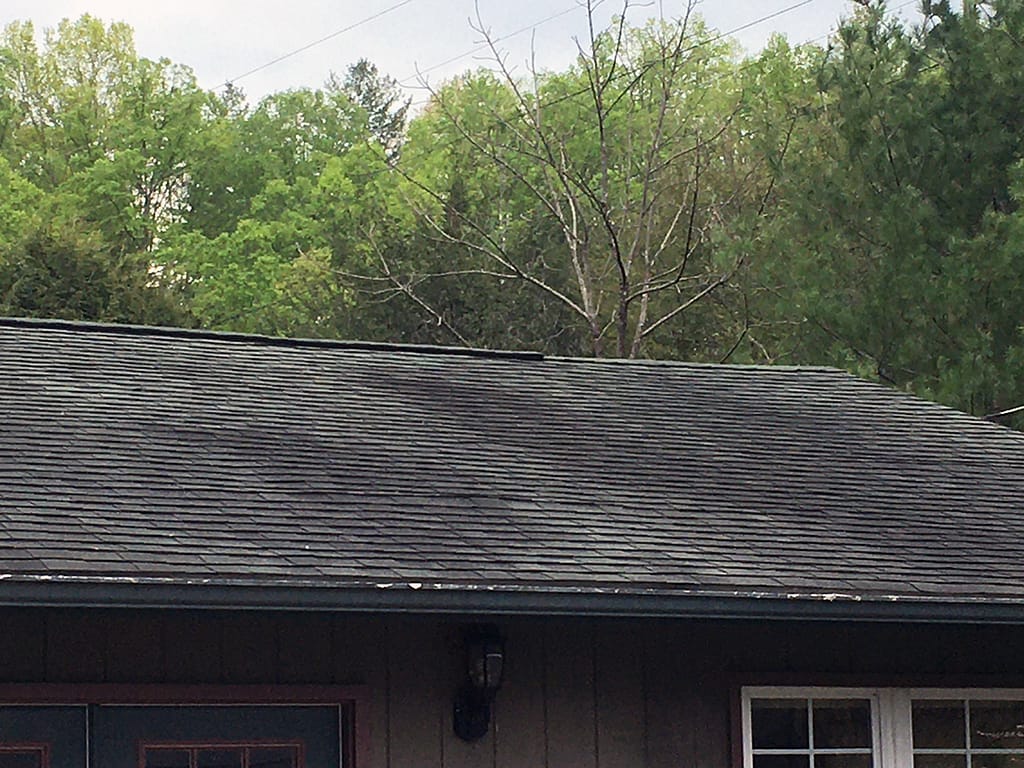
Those dark streaks running down your neighbor’s roof aren’t dirt or water stains. They’re alive… and if left unchecked, they’ll eat away at your shingles for years.
Every year, millions of homeowners across North America watch helplessly as their once-pristine roofs turn from crisp charcoal or slate gray to something closer to a forgotten hiking trail. The culprit? Gloeocapsa magma, a species of cyanobacteria, commonly called roof algae, that thrives in the damp, shaded conditions most roofs provide. What appears as black or dark green streaking is actually a buildup of the algae’s protective pigmented sheath, left behind as colonies spread and die.
For decades, the only reliable remedies were professional pressure washing, bleach treatments, and eventually full roof replacement. But the roofing industry has spent the last twenty-plus years developing a smarter answer: shingles engineered from the ground up to repel algae before it ever gets a foothold.
Why Algae Loves Your Roof
Asphalt shingles — the dominant roofing material in the U.S., covering an estimated 80% of homes — contain limestone filler as a cost-effective bulking agent. That limestone is a food source for algae. Couple that with the moisture retention of a north-facing slope, the shade from nearby trees, and the warmth radiating off a dark surface, and you have a near-perfect algae habitat sitting twenty feet above your living room.
The biological process is slow but relentless. Algae spores, carried by wind and birds, land on a roof surface. Given enough humidity, they germinate and form thin, nearly invisible biofilms. As colonies mature, they secrete that dark pigment as UV protection — which is when the staining becomes visible to a homeowner standing in the driveway. By that point, the algae has often been established for a year or more.
The Copper Solution — and its Evolution
The first major breakthrough in algae-resistant shingles came from an old observation: roofs near copper flashing — the metal trim used around chimneys and vents — rarely showed algae staining. Rain would leach trace amounts of copper ions off the flashing, and those ions proved lethal to algae colonies.
Roofing manufacturers seized on this principle in the early 2000s, developing granules coated with copper-containing compounds that could be blended into the standard ceramic granule mix already embedded in asphalt shingles. GAF introduced its StainGuard technology, and Owens Corning rolled out its StreakGuard series, both relying on this copper-granule approach. The idea was straightforward: as rain hits the roof, it carries microscopic amounts of copper across the shingle surface, creating an environment inhospitable to Gloeocapsa magma and its relatives.
“The roof of the future isn’t just waterproof — it’s biologically hostile to the organisms trying to colonize it.”
The early products worked, but imperfectly. Copper ions leach fastest when rainfall is heavy and the roof is new; over time, as the surface granules weather and the copper supply depletes, protection can wane. Some products also showed uneven distribution of treated granules, creating spotty coverage that algae could exploit. And there were environmental concerns: copper runoff into storm drains and garden beds raised questions about long-term ecological effects.
Next-Generation Algae Defense Technology
The industry has responded with a new generation of approaches that go beyond simply embedding copper in a granule coating.
Time-release mineral granules
Modern treated granules use encapsulation technology to slow the release of active copper or zinc compounds, extending effective protection well beyond what earlier surface-coating methods could achieve. The minerals are released gradually as water interacts with the granule matrix, rather than being rapidly depleted by early rains.
Zinc-based alternatives
Zinc compounds offer similar biostatic properties to copper with a somewhat different environmental profile. Some manufacturers have shifted to zinc-coated granules or blended zinc and copper formulations, providing manufacturers flexibility in balancing efficacy, longevity, and environmental compliance requirements.
Hydrophobic surface treatments
Algae needs moisture to establish a colony. Newer shingles from some manufacturers incorporate surface treatments that reduce water retention, causing rain to sheet off more completely. Less standing moisture means fewer opportunities for spores to germinate, addressing the root conditions rather than just the organism.
Polymer-modified asphalt blends
The asphalt base layer itself has evolved. Polymer modification improves the binding of protective granules to the surface, reducing granule loss from wind and hail. Tighter granule adhesion means the algae-defense compounds stay in place longer, maintaining a more consistent protective layer across the roof’s lifespan.
High-density granule loading
Rather than relying solely on chemical treatment, some manufacturers have increased the density of granule coverage on shingle surfaces, reducing the exposed asphalt area where algae can gain purchase. Fewer entry points means slower colonization even if protective chemistry diminishes over time.
What the Warranties Actually Mean
Most major shingle brands now offer algae-resistance warranties as part of their premium product lines — typically ranging from 10 to 30 years. But reading the fine print matters. Warranty coverage generally applies to visible staining caused by algae, not to the underlying structural condition of the shingle. And claims often require documentation that proper attic ventilation was maintained, that the roof wasn’t shaded by overhanging branches (which dramatically accelerate algae growth), and that any failure was specifically caused by algae and not another organism like moss or lichen.
Moss vs. algae vs. lichen — know the difference
Algae-resistant technology targets cyanobacteria specifically. Moss — a true plant with roots — and lichen — a fungus-algae symbiosis — require different treatments and aren’t covered by most algae-specific warranties. If you see fuzzy green growth with visible structure rather than flat dark streaking, you may be dealing with a more complex problem than algae-defense shingles alone can address.
Choosing algae-resistant shingles: what to look for
Not all “algae-resistant” labels are created equal. Here’s what matters when evaluating products:
Look for AR or “algae-resistant” designation
Reputable products carry an explicit algae-resistance designation and warranty term. A 10-year AR warranty is the baseline; 25–30-year coverage signals a manufacturer confident enough in their technology to back it long-term. Products from GAF (Timberline CS line), Owens Corning (Duration series), and CertainTeed (Landmark IR) have established track records in third-party testing.
Consider your climate
Algae is most aggressive in humid climates — the Gulf Coast, Pacific Northwest, Mid-Atlantic states, and much of the Southeast. If you’re in a drier region with low annual humidity, the premium for heavy-duty algae defense may be less justified. Homeowners in Cleveland, Atlanta, or Seattle, on the other hand, should treat algae resistance as a non-negotiable feature rather than an upgrade.
Pair with proper attic ventilation
No shingle technology compensates for a poorly ventilated attic that keeps the roof deck perpetually warm and damp. Proper ridge and soffit ventilation reduces moisture buildup and extends the life of any roofing system — it also makes algae-defense chemistry work more effectively by giving it fewer conditions to fight against.
Trim overhanging branches
Tree canopy over a roof does double damage: it deposits organic debris that feeds algae, and it blocks sunlight that would otherwise dry the surface between rain events. Keeping branches trimmed back from the roofline is one of the simplest things a homeowner can do to extend the life of algae-resistant shingles.
The Bottom Line
Algae defense technology has matured significantly since its early days. Modern copper- and zinc-infused granules, combined with improved asphalt formulations and time-release delivery systems, give homeowners a legitimate long-term tool against one of the most persistent sources of roof degradation and curb appeal loss.
They’re not magic — biology is patient, and no shingle lasts forever. But for homeowners in humid climates who’ve watched their roofs go dark within a decade of installation, upgrading to a premium AR shingle at replacement time is one of the most straightforward return-on-investment decisions in home maintenance. You’ll spend less on cleaning, protect your roof’s structural integrity longer, and preserve a look that actually matches what the brochure promised.
The organisms trying to colonize your roof have had millions of years to perfect their strategy. The roofing industry, at least, is finally catching up.