When most Central Ohio homeowners think about window sealing, they think about drafts. A cold breeze sneaking in during a January cold snap, or the AC working overtime on a sweltering July afternoon in Westerville or Dublin. That’s a fair association — air sealing absolutely affects comfort and energy bills.
But here’s what doesn’t get talked about nearly enough: the seals around your windows are also one of the quieter guardians of your home’s structural health. When they fail, the damage doesn’t stop at your utility bill. It can work its way into your walls, your framing, and eventually your foundation.
It Starts With Water, Not Air
Most people picture window seals as an air barrier. In practice, their more important job is often keeping water out. Ohio’s climate doesn’t do us any favors here — we get freeze-thaw cycles, wind-driven rain, and heavy spring storms that push moisture at windows from every angle.
When caulking cracks or weatherstripping compresses and fails, water finds the smallest opening. Once it’s past the exterior seal, it doesn’t evaporate quickly. It sits inside the wall cavity, against wood framing and sheathing that was never designed to stay wet.
The Slow Damage Nobody Notices Right Away
This is the part that makes window sealing a longevity issue, not just a comfort issue:
Wood rot and framing decay. Studs and sill plates around a window are structural. Chronic moisture exposure softens wood over months and years, sometimes long before it’s visible from inside the house.
Mold and air quality issues. Trapped moisture inside a wall cavity is exactly the environment mold needs. By the time it’s noticeable — a musty smell, discoloration on drywall — it’s usually been growing for a while.
Damage to siding and exterior trim. Water that gets behind a window often travels downward before it shows itself, which is why we frequently see siding or trim damage below a window that’s actually caused by a seal failure well above it. Homeowners in neighborhoods with older fiber cement or wood trim — common in parts of Powell, New Albany, and Granville — see this pattern often.
Compromised insulation. Wet insulation loses most of its R-value and can stay wet for a long time inside a closed wall, quietly reducing your home’s efficiency long after the leak itself would have seemed minor.
Foundation and drainage stress. In more severe or prolonged cases, water working its way down through wall cavities can eventually reach the base of the structure, adding to moisture loads your foundation and grading system have to manage.
None of this happens overnight. That’s exactly why it’s dangerous — it’s a slow leak of both moisture and money, and it’s easy to mistake for “just an old house.”
Why Window Sealing Deserves the Same Attention as Your Roof
We talk a lot about roof maintenance, attic ventilation, and gutter health because they’re central to keeping water moving away from a home the way it’s supposed to. Window seals are part of that same system. A house is really one connected building envelope — roof, siding, windows, and flashing all working together to manage water and air. A failure in one area often shows up as damage in another.
If you’ve had your roof or siding inspected recently but it’s been years since anyone looked closely at your window seals, there’s a real gap in that protection.
Signs Your Window Seals May Be Failing
A few things worth walking around your house and checking for:
- Cracked, brittle, or missing caulk around window frames
- Peeling paint or bubbling near window trim
- Soft or discolored wood at the sill or trim
- A musty smell near windows, even when they’re closed
- Visible daylight or a noticeable draft along the frame edge
- Condensation between window panes (a sign the window unit’s own seal has failed, separate from the perimeter caulk)
If you’re noticing any of these in your home — whether you’re in Hilliard, Gahanna, Grove City, or Canal Winchester — it’s worth having it looked at before the next round of Ohio weather puts it to the test.
A Small Job That Prevents a Big One
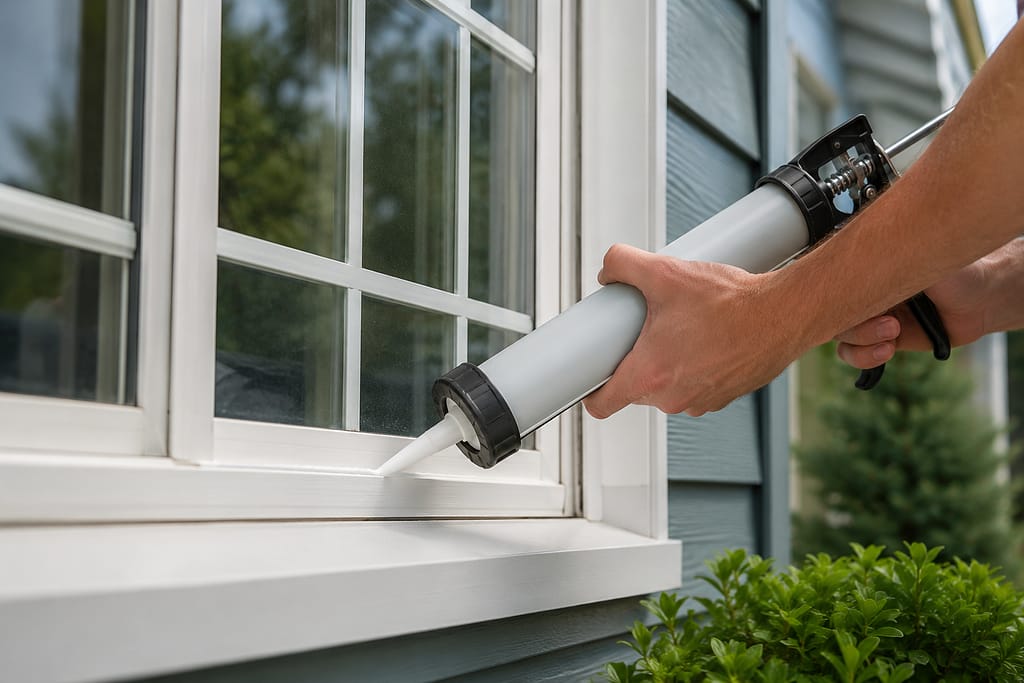
The reassuring part of this story is that window sealing is inexpensive and straightforward compared to the repairs that follow when it’s ignored. A few tubes of quality exterior caulk and an afternoon of attention is a very different project than replacing rotted framing or remediating mold.
We’re not in the window replacement business ourselves, but because we spend so much time looking at siding, trim, and the rest of a home’s exterior envelope, we often spot seal issues during roofing or siding inspections — and it’s the kind of thing worth mentioning to a homeowner even when it’s not why we were called out in the first place.
If you’ve got questions about how your windows, siding, and roof are working together to protect your home, feel free to reach out. No pressure, no sales pitch — just an honest look at what we see.