
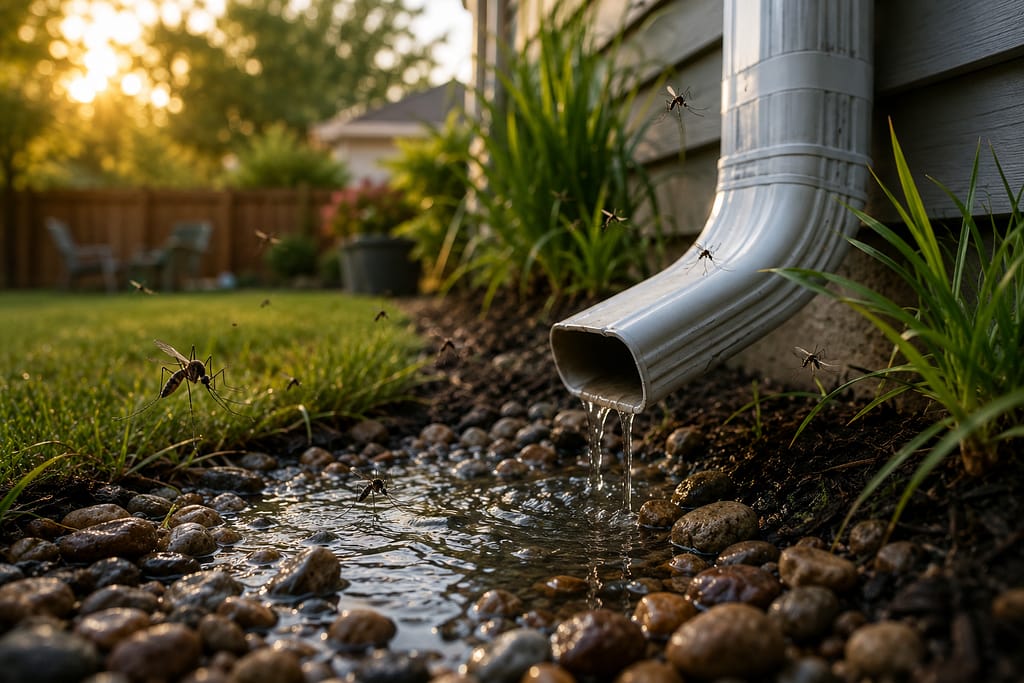
Nobody wants to spend a summer evening on the patio swatting mosquitoes. But before you reach for the bug spray or citronella candles, it’s worth looking up — literally — at your gutters. One of the most overlooked causes of a mosquito-infested backyard isn’t a pond, a birdbath, or a neglected kiddie pool. It’s standing water hiding in your gutter system, right above your head.
Here in Central Ohio, our humid summers and frequent thunderstorms create the perfect breeding ground for mosquitoes when a home’s drainage system isn’t doing its job. Let’s talk about why that happens and how to fix it.
Mosquitoes Only Need a Bottle Cap’s Worth of Water
Female mosquitoes lay eggs in standing water, and it doesn’t take much. Studies have shown mosquitoes can breed in as little as an inch or two of stagnant water, and eggs can hatch in as few as 7 to 10 days. That means any spot on your property that holds water for a week or more is a potential nursery.
Clogged or poorly pitched gutters are one of the most common — and most overlooked — culprits:
- Clogged gutters trap leaves, seeds, and shingle grit, creating a damp, debris-filled trough that holds water for days after a storm.
- Sagging or improperly pitched gutters create low spots where water pools instead of draining toward the downspout.
- Downspouts that dump water too close to the foundation create soggy, shaded areas in mulch beds or low spots in the yard — another favorite mosquito hangout.
- Disconnected or crushed downspout extensions cause water to collect right at the base of your home instead of carrying it safely away.
If you’ve noticed more mosquitoes near your porch, patio, or windows than in years past, your gutters are worth a closer look before you assume it’s just “an Ohio summer thing.”
The Chain Reaction of a Bad Drainage System
Gutters and downspouts aren’t just one component — they’re part of a larger drainage system that includes your roof, fascia, downspout extensions, and grading. When one part fails, water finds somewhere else to go, and that’s usually somewhere you don’t want it.
A clogged gutter that overflows during a summer thunderstorm can:
- Pool along your foundation, attracting mosquitoes and, over time, contributing to basement moisture issues
- Saturate mulch beds and landscaping, creating shaded, damp breeding pockets
- Erode soil and create small depressions in the yard that hold water long after the rest of the lawn has dried
- Contribute to fascia and soffit rot, which can create additional hidden pockets of moisture around the roofline itself
In other words, the mosquitoes in your backyard might just be a visible symptom of a drainage problem that’s also affecting your home’s structure.
What a Properly Functioning System Looks Like
A gutter and drainage system that’s doing its job should:
- Carry water off the roof efficiently with gutters sized correctly for your roof’s surface area and pitch
- Maintain proper pitch — roughly a quarter-inch of slope per 10 feet of gutter — so water flows steadily to the downspout instead of sitting still
- Stay clear of debris, especially under the mature tree canopy common in neighborhoods throughout Westerville, Dublin, Powell, New Albany, and Gahanna
- Move water at least 4-6 feet away from the foundation using properly connected downspout extensions
- Work with proper yard grading so water continues flowing away from the home rather than settling in low spots near the foundation
When all of these pieces are working together, water has nowhere to sit and stagnate — which means mosquitoes have nowhere to breed.
Simple Habits That Help Between Inspections
- Clean gutters at least twice a year — more often if your property has mature trees
- Check downspout extensions after storms to make sure they haven’t been knocked loose or crushed
- Walk your yard after a heavy rain and note any spots where water is still standing 24-48 hours later
- Consider gutter guards if leaf debris is a recurring issue on your property
When It’s Time for a Professional Look
If you’re regularly clearing debris but still seeing water pool near your gutters, downspouts, or foundation, the issue may be pitch, sizing, or damage rather than just clogging. That’s where a full roof and drainage inspection makes the difference — it looks at the whole system, not just the parts you can see from the ground.
At Roof Ohio, inspections are something we specialize in, separate from an insurance estimate. We walk the roofline, check gutter pitch and attachment, inspect downspout placement, and look for the kind of wear that leads to standing water — so small issues get caught before they turn into a soggy backyard, a mosquito problem, or worse, foundation trouble.
If your backyard has felt more like a mosquito magnet than a relaxing summer hangout, it might be time to have your gutters and drainage system looked at. Give us a call at 614-741-3333 or visit us here to schedule an inspection.