Most homeowners think about their roof in terms of what they can see — the shingles, the gutters, the flashing. But one of the biggest threats to your roof’s lifespan is completely invisible: heat and moisture trapped in your attic.
If you have a large attic and you’re relying on passive vents alone, there’s a good chance your roof is aging faster than it should. Active ventilation is the solution — and for large homes across Central Ohio, it can mean the difference between a roof that lasts 15 years and one that lasts 30.
Here’s what you need to know.
What Is Active Attic Ventilation?
Ventilation systems for attics fall into two categories:
Passive ventilation relies on natural air movement — soffit vents at the eaves draw in cool outside air while ridge vents or gable vents at the peak allow hot air to escape. It works on the principle that hot air rises. No moving parts, no power required.
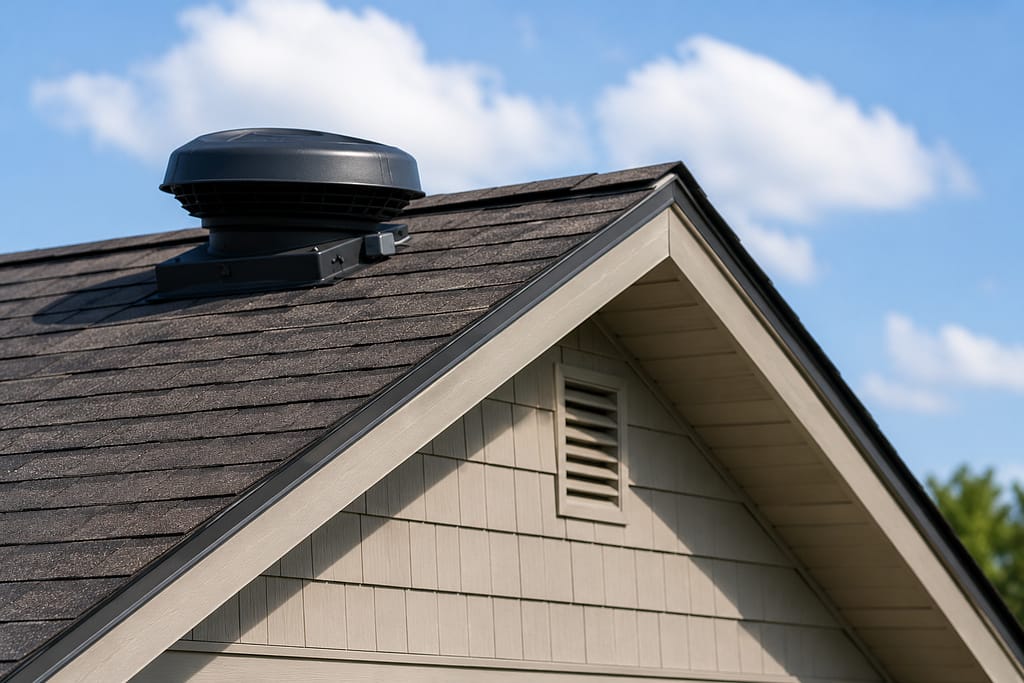
Active ventilation adds powered components — typically electric or solar-powered attic fans — that mechanically pull hot, humid air out of the attic and replace it with fresh outside air. Instead of hoping the breeze cooperates, active systems force proper airflow regardless of wind speed or direction.
For standard-sized attics, passive systems can be adequate. But for large attics — say, anything over 1,500 square feet of attic floor space — passive ventilation frequently falls short. Hot, stagnant air pockets form in corners and dead zones that natural convection never reaches. That’s where the damage begins.
How Poor Ventilation Destroys Your Roof From the Inside Out
Your attic is a heat and moisture chamber by nature. In an Ohio summer, an under-ventilated attic can reach temperatures of 150°F or higher. In winter, warm air from your living space rises into the attic and carries moisture with it. Left unchecked, both extremes cause serious, compounding damage.
Summer Heat Damage
Asphalt shingles are engineered to handle heat from the outside — UV radiation and direct sun exposure. What they’re not built for is being baked from below for months on end.
When attic temperatures spike, the decking (the plywood or OSB underneath your shingles) expands and contracts repeatedly through thermal cycling. Over time, this warps, cracks, and weakens the structural base your shingles depend on. The shingles themselves become brittle faster. Adhesive strips that hold shingles down in high winds lose their bond. Granules shed prematurely, stripping away the UV protection that gives shingles their rated lifespan.
The result: a roof rated for 25–30 years that starts showing its age at 12–15.
Winter Moisture and Ice Dams
Ohio winters bring a different problem. Warm air from your home rises into the attic, hits cold surfaces, and deposits moisture. Without adequate ventilation pushing that humid air out, it condenses on the underside of your roof deck. Over time, repeated wetting and drying causes the wood to swell, delaminate, and rot. Nails lose their grip. Mold takes hold.
Then there’s the ice dam problem — one that Central Ohio homeowners know well. When attic heat is uneven (warmer near the ridge, cooler at the eaves), snow melts in the middle of your roof and refreezes at the cold overhang. That ice dam backs water up under your shingles, where it has nowhere to go but into your home. Active ventilation keeps attic temperatures consistent across the entire roof surface, dramatically reducing ice dam formation.
Why Large Attics Are Especially Vulnerable
Ventilation is often calculated based on attic square footage. The standard building code minimum is 1 square foot of net free ventilation area for every 150 square feet of attic floor space — though many experts recommend exceeding that for Ohio’s climate.
The problem with large attics isn’t just total volume — it’s geometry. A sprawling ranch-style home, a large two-story colonial, or a home with complex rooflines often has attic spaces that are long, segmented, or irregular. Natural convection tends to create good airflow in some areas and near-zero airflow in others. Hot spots build up in dead corners. Moisture lingers in low-pitch sections.
Active ventilation solves this because it doesn’t rely on luck. A properly sized powered attic fan — or a strategically placed system of fans — creates deliberate, directed airflow that reaches the entire attic footprint. There are no dead zones.
The Lifespan Math: What You’re Actually Protecting
Let’s put some numbers around this.
A quality architectural shingle roof for a large Central Ohio home might run $15,000–$25,000 installed. That roof carries a manufacturer warranty of 25–30 years — but those warranties assume proper ventilation. In fact, most major shingle manufacturers, including GAF and Owens Corning, include ventilation requirements in their warranty terms. Inadequate ventilation can void your coverage entirely.
Now consider this: active ventilation systems — including powered fans, solar fans, or whole-attic ventilation upgrades — typically run $500–$2,500 depending on attic size and configuration. A properly ventilated attic can extend shingle life by 20–40%, according to roofing industry data. On a $20,000 roof, even a 5-year extension in lifespan represents thousands of dollars in deferred replacement costs.
The math isn’t close. Active ventilation is one of the highest-ROI investments available in residential roofing.
Signs Your Large Attic May Be Under-Ventilated
You don’t need to crawl into your attic to spot the warning signs. Watch for:
- Higher energy bills in summer — If your HVAC is working overtime, your attic may be dumping heat into your living space
- Ice dams forming along your eaves in winter
- Shingles that appear aged, curling, or granule-bare ahead of schedule
- Musty smells in upstairs rooms — often a sign of attic moisture
- Visible staining or water marks on your attic rafters or deck (if you do go up there)
- Inconsistent attic temperature — warm in the center, cooler at the edges
Any one of these warrants a professional inspection. Several of them together means it’s time to act.
What a Proper Active Ventilation System Looks Like
There’s no one-size-fits-all solution — the right system depends on your attic’s size, shape, and existing passive ventilation. But here’s what a well-designed active system typically includes:
Balanced intake and exhaust. Active fans are only as effective as the air they have to work with. Soffit vents (intake) must be adequate to allow replacement air to enter as hot air is expelled. We often find homes with powered fans but clogged or undersized soffits — the fan is fighting a vacuum.
Correct fan sizing. Powered attic fans are rated in CFM (cubic feet per minute). An undersized fan for a large attic barely makes a dent. We calculate the right capacity based on your specific attic volume and configuration.
Strategic placement. In irregular or segmented attics, fan placement matters. Putting a single fan at the peak of a sprawling attic may leave entire wings unventilated.
Solar vs. electric. Solar-powered attic fans have improved significantly and work well in Ohio’s climate for many applications. Electric fans offer more consistent performance on cloudy days and in deep winter — something to consider given Central Ohio’s overcast winters.
A Note on Ventilation and Insurance Claims
If your roof sustains storm damage and you file an insurance claim, ventilation history matters more than most homeowners realize. Adjusters and insurers look at the condition of your roof deck, shingle adhesion, and granule coverage when evaluating claims. A roof that’s clearly been heat-damaged from poor ventilation — even if a storm was the triggering event — can complicate your claim or result in reduced payouts.
Maintaining a properly ventilated attic is part of demonstrating that your roof has been reasonably maintained — which supports your position in any insurance negotiation.
The Roof Ohio Approach
When we inspect a large home here in Central Ohio, attic ventilation is always part of our evaluation. We’ve seen too many roofs — good materials, solid installation — fail prematurely because the attic beneath them was a heat trap.
If you’re not sure whether your attic ventilation is keeping up, we’ll take a look. We’ll assess your current setup, identify any dead zones or deficiencies, and give you honest recommendations — whether that means adding soffit vents, upgrading to active ventilation, or a combination of both.
Your shingles take enough punishment from Ohio’s weather. Don’t let the attic get them too.
Ready to protect your investment? Contact Roof Ohio for a free roof and ventilation inspection. We serve Westerville, Dublin, Powell, New Albany, Gahanna, Grove City, and communities throughout the Columbus metro area.