When most homeowners think about getting a new roof, their minds go straight to shingles — the color, the style, the warranty. And while shingles absolutely matter, they’re only as good as what’s underneath them. That hidden foundation is called roof decking (also known as roof sheathing), and it plays a bigger role in the performance and longevity of your new roof than most people realize.
If you’re planning a roof replacement, or even just curious about what goes into one, here’s what you need to know about roof decking and why it deserves your attention.
What Is Roof Decking?
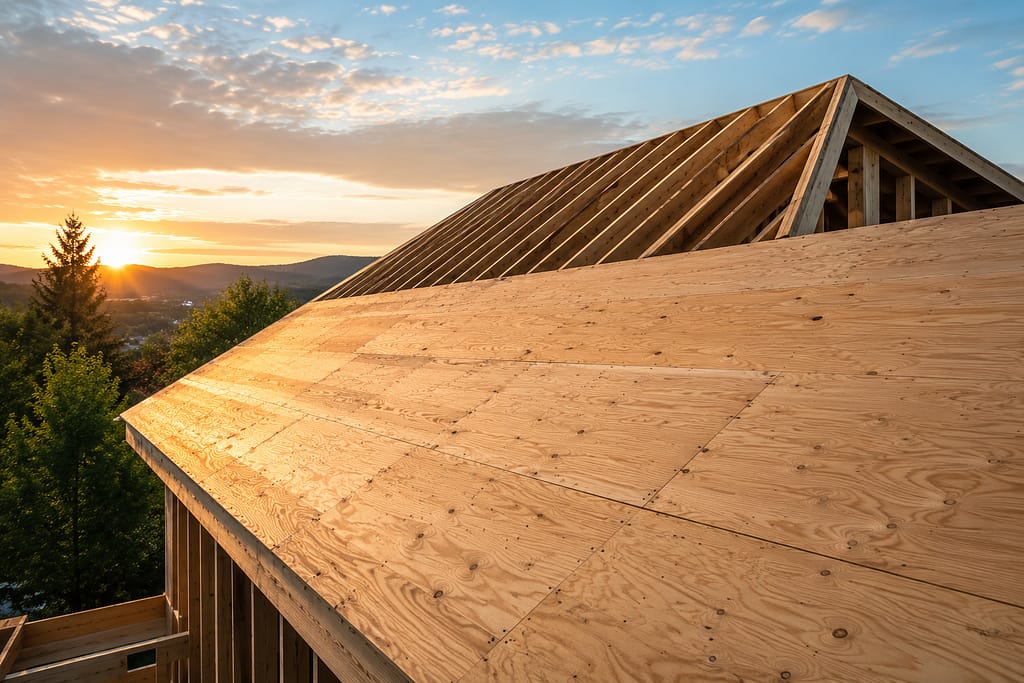
Roof decking is the flat, solid surface that covers your home’s rafters or trusses and serves as the base layer for everything else on your roof. Think of it as the subflooring of your roof system. It’s nailed directly to the structural framework of your home, and on top of it goes underlayment, ice and water shield, and finally your shingles.
The most common decking materials today are:
- OSB (Oriented Strand Board) — the industry standard in most new construction and replacements; affordable and structurally sound
- Plywood — traditionally preferred for its moisture resistance and dimensional stability; still widely used
- Older wood plank decking — found in homes built before the 1970s; individual boards rather than sheets
The type, condition, and installation quality of your decking affects nearly everything about how your new roof performs.
How Roof Decking Affects Your New Roof
1. It Determines Whether Your Shingles Lie Flat
Shingles need a smooth, even surface to lay correctly. If your decking has soft spots, warped panels, swollen edges, or areas of rot, those imperfections telegraph right through to the surface of your roof. You may notice wavy or uneven shingles — and beyond the cosmetic issue, improper shingle alignment can allow water to work its way underneath.
Before any new shingles go down, a reputable roofing contractor will walk your existing decking and identify any damaged panels that need to be replaced. This isn’t just cosmetic — it’s essential for a proper installation.
2. It Affects How Well Nails Hold
Shingles are fastened to the decking with roofing nails. If the decking is soft, rotted, or thin, nails won’t seat properly — they may pull out over time or fail to create a tight hold from the start. This is especially dangerous in high-wind areas, where inadequate fastening is one of the leading causes of shingle blow-off.
Decking that’s in good shape gives nails something solid to bite into, which means your shingles stay put through wind, rain, and storms.
3. Its Thickness Matters for Code Compliance and Structural Support
Most building codes require a minimum decking thickness — commonly 7/16″ for OSB or 3/8″ for plywood. If your existing decking is undersized (which can happen in older homes or when shortcuts were taken), it may need to be upgraded to meet current standards before new shingles can be installed.
Thicker decking also provides better structural support, reduces the risk of sagging between rafters, and gives your roof system more overall rigidity.
4. It Plays a Role in Moisture Management
Even the best roofing system will see some amount of moisture intrusion over its lifetime. Decking is your secondary line of defense. OSB and plywood both have moisture-resistant properties, but they differ in how they respond to prolonged exposure. Plywood tends to hold its shape better when wet and dries out more gracefully. OSB can swell at the edges if exposed to standing water — something a good installation and proper ventilation can help prevent.
When decking is compromised by moisture, it becomes a breeding ground for mold and rot — problems that will spread to your rafters, attic insulation, and eventually your interior if left unchecked.
5. It Impacts Your Roofing Warranty
Here’s something many homeowners don’t know: most shingle manufacturer warranties require that shingles be installed over sound, solid decking. If your shingles are installed over damaged or substandard decking, you may unknowingly void your warranty before a single raindrop falls.
If you’re investing in a premium shingle with a 30- or 50-year warranty, it’s worth making sure the decking beneath it won’t compromise that coverage.
What to Expect During a Roof Replacement
A thorough roofing contractor won’t just tear off old shingles and nail new ones down. They’ll:
- Inspect the existing decking after tear-off, walking the surface and probing for soft spots
- Replace any damaged panels — typically billing by the sheet, so you only pay for what needs to go
- Ensure proper spacing between OSB panels (usually 1/8″ expansion gaps) to allow for natural movement
- Confirm thickness and code compliance before proceeding
Ask your contractor upfront how they handle decking replacement and what their per-sheet cost is. Transparency here is a sign of a professional operation.
Signs Your Decking May Need Attention
You may not be able to see your decking from ground level, but there are signs that can point to trouble:
- Sagging or dipping areas on your roofline
- Spongy or soft spots if you’re able to walk on the roof
- Staining or water marks in your attic on the underside of the decking
- Visible mold or rot in the attic
- A very old roof that was never replaced (original decking may be beyond its useful life)
If you notice any of these, mention them to your roofing contractor and ask for a thorough decking inspection before new materials go down.
The Bottom Line
Roof decking is the foundation of your entire roof system. Without a sound, solid base, even the highest-quality shingles won’t perform the way they’re designed to. When you’re investing in a new roof, don’t let decking be an afterthought — ask about it, budget for potential repairs, and make sure your contractor inspects it carefully before installation begins.
A great roof starts from the inside out. When your decking is solid, everything above it has a fighting chance to last.