Whether you’re getting your first roof replacement estimate or just noticed a suspicious wet spot on your ceiling, talking to a roofer can feel like stepping into a foreign country. Decking, flashing, drip edge — the jargon flies fast, and nodding along only gets you so far.
This guide breaks down the most important roofing terms in plain English, so you can have an informed conversation with your contractor, understand what you’re paying for, and avoid being caught off guard when a problem arises.
The Basic Structure
Roof Deck (or Decking)– The roof deck is the structural base of your roof — the flat wooden surface (typically plywood or OSB) that everything else is installed on top of. Think of it as the foundation. When decking is rotted or damaged, it needs to be replaced before new shingles go down, which can add cost to a job.
Rafters– Rafters are the sloped wooden beams that run from the ridge of the roof down to the eaves, giving the roof its shape. They support the decking from underneath.
Trusses– In many modern homes, trusses replace traditional rafters. These are pre-engineered triangular frames that provide structural support across a wider span. You’ll often hear the terms “rafter” and “truss” used interchangeably, but they’re built and installed differently.
Ridge– The ridge is the very top horizontal line of the roof, where two sloping sides meet at a peak. The ridge is one of the most vulnerable spots for water infiltration, which is why it gets special treatment during installation.
Roofing Materials
Shingles– Shingles are the overlapping individual pieces that make up the outermost layer of most residential roofs. Asphalt shingles are by far the most common in the U.S., but you’ll also find wood shake, metal, slate, and tile shingles on the market.
Underlayment– Underlayment is a water-resistant or waterproof layer installed directly on the decking, beneath the shingles. It acts as a secondary barrier against moisture. Common types include felt paper (15 or 30 lb.) and synthetic underlayment, which tends to be more durable.
Ice and Water Shield– A specialty self-adhering membrane typically installed in vulnerable areas — eaves, valleys, and around penetrations — where ice dams or heavy water flow can force moisture underneath shingles. Many building codes require it in cold climates.
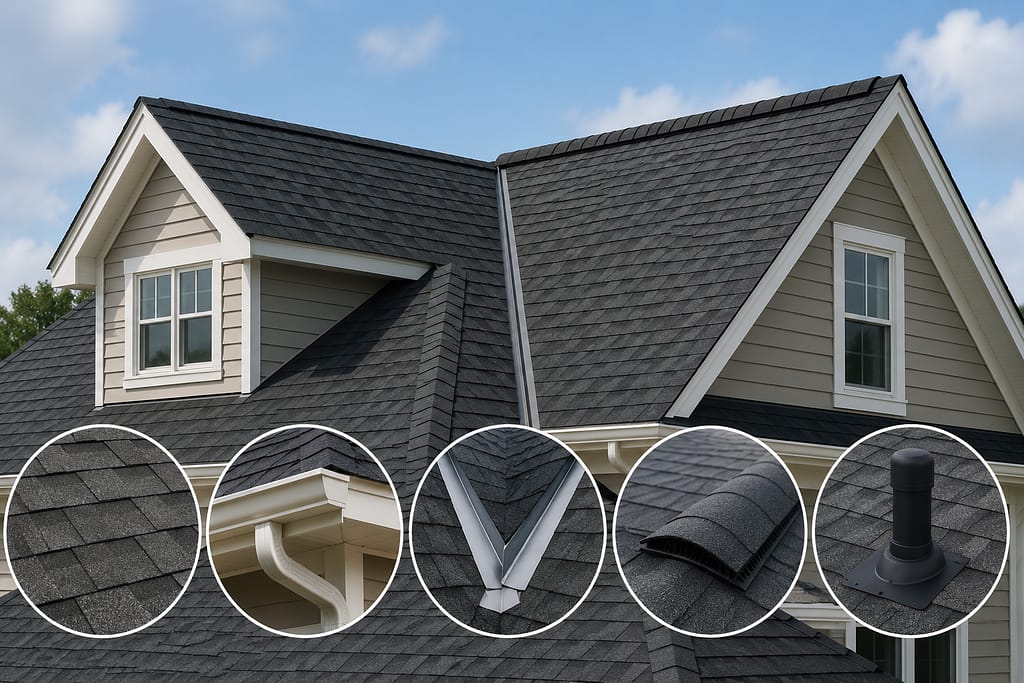
Ridge Cap Shingles- These are specially shaped shingles designed to cover the ridge of the roof. They’re thicker and pre-bent to straddle the peak, providing both protection and a finished look.
Water Management
Flashing– Flashing is thin sheet metal (usually aluminum, galvanized steel, or copper) installed at joints and transitions — around chimneys, skylights, vents, and where the roof meets a wall. Its job is to direct water away from these vulnerable seams. Failed flashing is one of the most common causes of roof leaks.
Step Flashing– A type of flashing used where a roof slope meets a vertical wall. It consists of L-shaped pieces that “step” up alongside the wall in alternating layers with the shingles. You’ll often see this at dormers or side walls.
Counter Flashing– Counter flashing is installed over step flashing, embedding into the mortar of a chimney or masonry wall to seal the top edge. Together, step flashing and counter flashing form a complete waterproof system.
Drip Edge– A metal strip installed along the eaves and rakes of the roof that directs water away from the fascia and into the gutters. It prevents water from wicking back under the shingles and rotting the decking. Often overlooked, it’s an inexpensive but important detail.
Valley– A roof valley is the internal angle formed where two sloping roof planes meet. Because they channel large volumes of water, valleys require careful installation — either with metal valley flashing or woven/cut shingles.
Roof Geometry
Pitch (or Slope)– Pitch describes how steep your roof is, expressed as a ratio of vertical rise to horizontal run — for example, a 6:12 pitch rises 6 inches for every 12 inches of horizontal distance. Pitch affects everything from material selection to installation cost. Low-slope roofs (under 4:12) often require different materials than steep-slope roofs.
Eave– The eave is the lower edge of the roof that overhangs beyond the exterior wall. It helps protect the siding and foundation from rain runoff. The underside of the eave is called the soffit.
Rake– The rake is the sloped edge of the roof that runs from the eave up to the ridge along the end wall of the house (the triangular “gable” side). Like eaves, rakes get drip edge and trim treatment.
Soffit– The soffit is the finished underside of the roof overhang (eave). It often contains ventilation openings that allow air to flow into the attic.
Fascia– The fascia is the vertical board that runs along the edge of the roof at the eave, typically where gutters are attached. It gives the roofline a clean finish and helps support the gutter system.
Hip Roof– A roof where all four sides slope downward to the walls, meeting at a ridge at the top. Hip roofs are generally more wind-resistant than gable roofs and are common in hurricane-prone regions.
Gable Roof– The classic A-frame shape: two sloping sides that meet at a central ridge, with vertical triangular walls (“gables”) at each end. Simple to build and drain, but the gable ends can be more vulnerable in high winds.
Ventilation
Ridge Vent– A continuous vent installed along the entire ridge of the roof that allows hot, moist air to escape from the attic. Works best in combination with soffit vents to create a balanced airflow system.
Soffit Vent– Vents in the soffit that allow outside air to enter the attic. Fresh air flows in at the bottom (soffit) and hot air exits at the top (ridge), creating natural convection that keeps the attic cool and dry.
Attic Ventilation– Proper attic ventilation isn’t just about comfort — it prevents moisture buildup that leads to mold and rot, reduces the risk of ice dams in winter, and extends the life of your roofing materials by keeping temperatures regulated.
Common Measurements
Square– Roofing is measured in “squares,” where one square equals 100 square feet of roof surface. When a contractor gives you a quote for “30 squares,” that means your roof covers 3,000 square feet. Materials like shingles are sold and priced by the square.
Bundle– Shingles are packaged and sold in bundles. Typically, three bundles of standard asphalt shingles cover one square, though heavier or premium shingles may come four or five bundles to a square.
When Things Go Wrong
Granule Loss– The surface of asphalt shingles is coated with mineral granules that protect against UV rays and weather. As shingles age, they shed these granules — you’ll often notice them collecting in gutters. Heavy granule loss is a sign that shingles are nearing the end of their life.
Blistering– Circular raised bumps on shingles caused by trapped moisture or volatile gases escaping during manufacturing or installation. Blistering compromises the shingle surface and can lead to premature failure.
Ice Dam– A ridge of ice that forms at the edge of a roof when heat escaping from the attic melts snow, which then refreezes at the cooler eaves. Ice dams can force water back under shingles, causing leaks and interior damage. Proper insulation and ventilation are the best prevention.
Ponding Water– Water that collects and stands on a flat or low-slope roof for more than 48 hours after rain. It accelerates deterioration of roofing materials and signals drainage problems.
Working with Contractors
Tear-Off– Removing all existing roofing materials down to the decking before installing new ones. A full tear-off adds labor and disposal costs but allows for a thorough inspection of the deck and a cleaner, longer-lasting installation.
Re-Roof (or Overlay)– Installing new shingles directly over existing ones without tearing off the old layer. It’s faster and cheaper upfront, but most building codes only allow one layer of shingles over an existing layer, and it can mask underlying problems.
Warranty– Roofing warranties come in two types: the manufacturer’s material warranty (covering defects in the shingles themselves) and the contractor’s workmanship warranty (covering installation errors). Always get both in writing, and understand what voids each one.
Final Thoughts
You don’t need to become a roofing expert, but knowing these terms puts you in a much stronger position — whether you’re reviewing a bid, filing an insurance claim, or just trying to understand what went wrong after a storm. When a contractor mentions “step flashing at the chimney” or talks about “ice and water shield at the valleys,” you’ll know exactly what they mean and why it matters.
The best roofing conversations happen when homeowners are informed. Now you’re ready for one.