
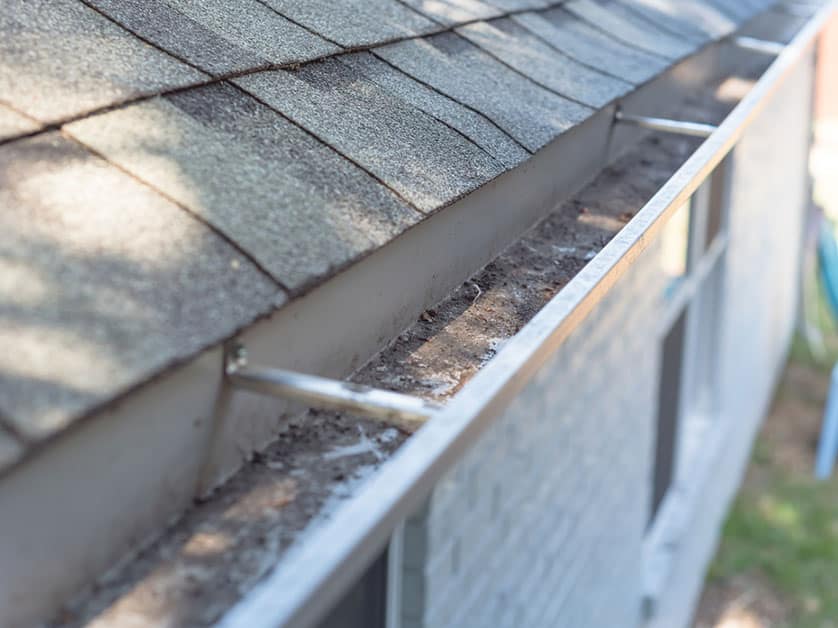
Most homeowners think of their gutters and their roof as two separate systems: one keeps water off the house, the other keeps water out of it. In practice, the two work as a team. When gutters stop pulling their weight, the roof absorbs the consequences, and two of the sneakiest ways that happens are clogging and the granule loss that quietly piles up in all that debris.
How a Clogged Gutter Becomes a Roof Problem
Gutters exist to move water off the roofline before it has a chance to pool. When leaves, seed pods, and shingle grit choke that path, the water has to go somewhere else, and “somewhere else” is rarely good news for the roof above it.
Once a gutter backs up, standing water sits against the lowest few feet of the roof at the eaves far longer than that section was ever designed to handle. The extra moisture softens the wood decking under the shingles and works against the seal that’s supposed to keep water out. The fascia board, the trim piece the gutter actually hangs from, takes the worst of it and is often the first thing to rot. Once fascia starts failing, the gutter can sag or pull loose, and it’s common for drip edge flashing or even a few shingle tabs at the roofline to go with it.
In central Ohio, winter makes this worse. A clogged gutter holds melting snow right at the roof edge, where it refreezes overnight into an ice dam. That dam blocks the next round of melt from draining anywhere, so the water backs up under the shingles and finds its way into the attic, sometimes showing up as a ceiling stain in a room nowhere near where the actual problem is happening.
The Warning Sign Hiding in the Muck: Granule Loss
Asphalt shingles aren’t just colored plastic. Embedded in the top coating are small mineral granules whose job is to shield the asphalt underneath from UV rays, add fire resistance, and give the shingle enough weight and texture to shed water the way it’s supposed to. Every shingle loses a few granules over its life, and a noticeable amount right after a new roof goes on is normal, since that’s just the loose factory granules washing off.
What isn’t normal is a steady, growing amount of granules collecting in the gutters year after year. That pattern usually means the asphalt coating is wearing thin and the shingle is going bald in spots. Once enough granules are gone, the asphalt mat underneath is exposed directly to sun and weather, and it starts cracking, curling, and losing its grip on the roof much sooner than it should.
Here’s the catch: the gutters are often the first place this shows up, long before anyone would notice it by looking at the roof from the ground. But if those gutters never get cleaned out, the granules just wash through unnoticed, and the earliest warning sign gets bagged up with the leaves.
Why These Two Problems Make Each Other Worse
Clogging and granule loss aren’t unrelated; they tend to show up in the same spots for the same reasons. The lowest edge of a roof and the valleys that feed into the gutters are exactly where water moves slowest and sits longest, which is also where shingles take the most abuse and shed granules fastest. A clog traps moisture right against that already-vulnerable section, which speeds up the granule loss and decking damage happening there, which adds more debris and more blockage, which traps even more water. It’s a loop, and it’s one of the more common ways a simple gutter problem quietly turns into a roof replacement.
Catching It Before It Becomes a Bigger Repair
A few habits go a long way toward keeping gutters and roof working together instead of against each other:
- Clean gutters at least twice a year in this climate: once in spring after seed pods and pollen debris, once in fall after leaves drop, plus an extra check after any major storm.
- While the gutters are open, look at what’s actually sitting in them. A heavy, consistent layer of granules is worth a roof inspection, not just a gutter scoop-out.
- Check the fascia boards for soft spots, dark staining, or bubbling paint, all signs that water has been sitting longer than it should.
- Gutter guards can cut down on leaf clogs, but they still need periodic checks. They reduce the work, not the need for an occasional look.
If it’s not clear what’s being looked at, that’s a reasonable point to bring in a professional rather than guess.
A Local Perspective on Gutters and Roofs
Mature tree canopies are part of what makes neighborhoods across Westerville, Dublin, Powell, Hilliard, Gahanna, New Albany, Pickerington, Grove City, and Canal Winchester so pleasant to live in, and they’re also why local gutters tend to fill up faster than a generic maintenance schedule accounts for. Add in central Ohio’s freeze-thaw winters and our share of summer storms, and gutter neglect here turns into roof damage faster than it would in a milder, less wooded climate.
Roof Ohio looks at the roof and the gutters as one connected system during every inspection, because that’s how they actually behave. If it’s been a while since either one was checked, or granules have started piling up where the leaves collect, it’s worth getting both looked at together before a small backup turns into a much bigger repair.