
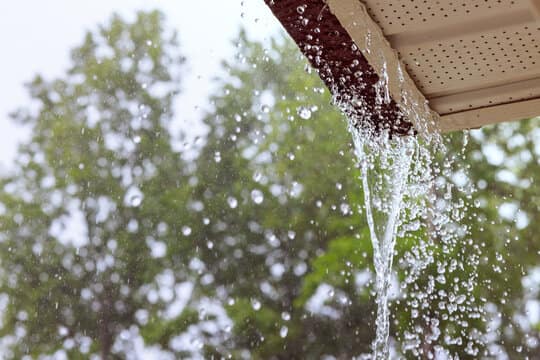
There’s nothing quite like a heavy rainstorm to reveal a problem you didn’t know you had. If you’ve stepped outside — or looked out a window — and noticed water cascading over the sides of your gutters like a miniature waterfall, you’re not alone. Overflowing gutters are one of the most common home maintenance complaints, and the good news is that the causes are almost always fixable. Here’s what’s probably going on.
1. Your Gutters Are Clogged
This is the big one. Leaves, twigs, seed pods, roof granules, and general debris accumulate in gutters over time, forming a dam that water simply cannot pass through. Once a blockage forms, rain has nowhere to go but over the edge.
If you haven’t cleaned your gutters in the last six months — or ever — this is almost certainly your culprit. A good rule of thumb is to clean gutters at least twice a year: once in late spring and once in late fall after the leaves have dropped.
2. The Downspouts Are Blocked
Even if your gutters themselves look clear, a clog in the downspout can bring the whole system to a halt. Debris funnels down into the spout and can form surprisingly stubborn blockages deep inside where you can’t easily see them.
You can test your downspouts by running a garden hose into the top. If water backs up instead of flowing freely out the bottom, you’ve got a blockage. A plumber’s snake or a strong burst from a hose nozzle can often clear it out.
3. Your Gutters Are Improperly Pitched
Gutters aren’t meant to sit perfectly level — they’re designed with a slight slope (about a quarter inch of drop for every 10 feet of gutter) that guides water toward the downspouts. If that pitch has shifted due to age, settling, or improper installation, water will pool in the low spots and eventually spill over.
This one’s a little harder to diagnose without getting up on a ladder. Look for standing water in your gutters after rain, or run a hose through them and watch where the water goes.
4. The Gutters Are Too Small for Your Roof
Standard 4-inch gutters work fine for most homes, but if you have a steeply pitched roof, a large roof surface area, or you live somewhere with heavy rainfall (hello, Cleveland), you may simply be overwhelming your system. During a hard downpour, the volume of water rushing off your roof can exceed what undersized gutters can handle — no matter how clean they are.
Upgrading to 5- or 6-inch gutters, or adding more downspouts, can solve this problem for good.
5. The Gutters Are Damaged or Sagging
Gutters take a beating over the years. Hangers can loosen, seams can separate, and sections can sag or pull away from the fascia board. A sagging section creates a low point where water collects and eventually overflows, while a gap at a seam lets water escape before it ever reaches the downspout.
Walk around your home after rain and look for dripping seams or sections that look like they’re pulling away from the roofline — these are signs it’s time for repair or replacement.
The Bottom Line
Overflowing gutters are more than just an annoyance — left unchecked, they can damage your foundation, erode landscaping, cause basement flooding, and lead to rot along your fascia and soffits. The fix is usually simpler than the damage it prevents.
Start with a thorough cleaning and inspection. If your gutters are clear and still overflowing, work through the list above. And if you’re not comfortable getting up on a ladder yourself, a professional gutter cleaning service can diagnose and fix most of these issues quickly and inexpensively.
Your gutters work hard. A little attention goes a long way.