When homeowners think about cutting energy costs, they usually think about smart thermostats, new windows, or better insulation. The roof rarely makes the list. That’s a mistake — because your roof is one of the largest surfaces on your home, and it’s in constant battle with the elements 24 hours a day, 365 days a year. What it’s made of, how it’s installed, and how well it’s maintained can have a dramatic impact on your heating and cooling bills.
Here’s what you need to know.
The Roof as a Thermal Barrier
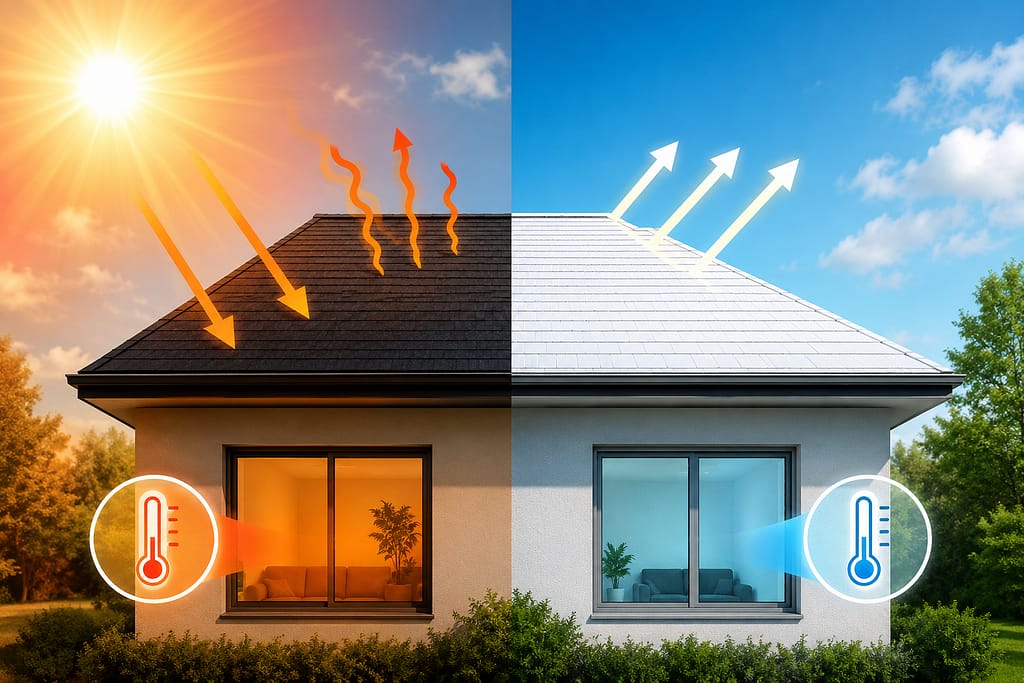
Think of your roof as the first line of defense between your living space and the outdoor climate. In summer, solar radiation beats down on your roof surface, and depending on the material and color, that heat either gets absorbed and transferred into your home — or reflected away. A dark asphalt shingle roof on a hot day can reach surface temperatures of 150°F or higher. That heat radiates into your attic and, eventually, into your living space, forcing your air conditioner to work overtime.
In winter, the equation flips. A poorly insulated or ventilated roof allows heat to escape from your home, driving up heating costs and potentially creating ice dams that damage the structure itself.
The bottom line: your roof isn’t just a weatherproof shell. It’s an active participant in your home’s thermal performance.
Cool Roofs: Reflecting the Problem Away
One of the most impactful developments in energy-efficient roofing is the concept of the cool roof — any roofing system designed to reflect more sunlight and absorb less heat than a standard roof.
Cool roofs achieve this through two properties:
- Solar reflectance — the ability to reflect sunlight (including invisible infrared radiation) away from the surface
- Thermal emittance — the ability to release any absorbed heat rather than transferring it indoors
Cool roofs come in many forms: specially coated metal roofs, light-colored tiles, reflective membranes on flat commercial roofs, and even treated asphalt shingles. The U.S. Department of Energy’s ENERGY STAR program certifies roofing products that meet minimum reflectance and emittance standards, making it easy for homeowners to identify high-performing options.
The energy savings can be substantial. Studies have shown that cool roofs can reduce peak cooling demand by 10–15%, with even greater gains in hot, sunny climates like the American Southwest or Southeast.
Material Matters: A Roofing Comparison
Not all roofing materials are created equal when it comes to energy performance.
Asphalt Shingles are the most common roofing material in the U.S. Traditional dark-colored asphalt shingles are among the least energy-efficient options, though manufacturers now offer “cool” asphalt shingles with reflective granules. These can significantly outperform their conventional counterparts without changing the look of your home.
Metal Roofing is one of the top performers in energy efficiency. Metal naturally reflects solar radiation, and when coated with special pigments or finishes, it can reflect up to 70% of solar energy. Metal roofs are also extremely durable — lasting 40–70 years — which means lower lifecycle environmental impact.
Clay and Concrete Tiles offer excellent thermal mass. Their curved shape also allows air to circulate underneath the tiles, creating a natural buffer between the sun-heated surface and the roof deck. These are particularly effective in warm climates.
Slate is dense, durable, and a good natural insulator. Like clay tile, its longevity (100+ years) gives it a strong environmental profile over time, though the upfront cost is significant.
Green (Living) Roofs take energy efficiency to an entirely different level. A layer of soil and vegetation provides natural insulation, absorbs rainwater, reduces urban heat island effects, and can dramatically lower rooftop surface temperatures. They’re more common on commercial buildings but are growing in residential use.
Insulation and Ventilation: The Unsung Heroes
Even the most reflective roofing material won’t do much good if your attic is a poorly ventilated heat trap. Proper attic insulation and ventilation work hand-in-hand with your roofing material to create a complete thermal system.
Attic insulation keeps conditioned air inside your home where it belongs. The EPA estimates that homeowners can save an average of 15% on heating and cooling costs simply by air sealing and adding insulation in attics, crawl spaces, and basement rim joists.
Attic ventilation allows hot air to escape in summer and prevents moisture buildup in winter. A well-ventilated attic stays much closer to outdoor air temperature rather than acting as a heat reservoir. Ridge vents, soffit vents, and gable vents all play a role in keeping air moving through the attic space.
Without adequate ventilation, even a high-performance cool roof will underperform — and you may also face moisture problems, accelerated shingle degradation, and potential mold growth.
Roof Color: Small Choice, Big Impact
It’s almost too simple, but roof color is one of the most immediate factors in energy performance. Light-colored roofs reflect significantly more solar radiation than dark ones. If you live in a predominantly hot climate, choosing a lighter-colored roofing product — even in traditional materials like asphalt — can meaningfully reduce your cooling load.
That said, color is a two-way street. In colder climates, a darker roof can be an asset in winter, absorbing solar heat and helping to melt snow. The right choice depends on where you live and which season dominates your energy bills.
The Financial and Environmental Case
Energy-efficient roofing isn’t just about comfort — it makes economic sense. Reduced energy consumption translates directly to lower utility bills. Depending on your climate, roofing material, and current system, upgrading to a high-performance roof can save hundreds of dollars per year. Over the lifespan of a roof, that adds up to thousands.
There’s also a broader environmental benefit. Buildings account for roughly 40% of total energy consumption in the United States. Making roofs more efficient is one of the most scalable ways to reduce that footprint at a national level. Cool roofs, in particular, also help combat the urban heat island effect — the tendency for cities to be significantly warmer than surrounding rural areas due to heat-absorbing surfaces like dark pavement and rooftops.
Some homeowners may also qualify for federal or state tax credits, utility rebates, or other incentives when installing energy-efficient roofing systems. It’s worth checking the Database of State Incentives for Renewables & Efficiency (DSIRE) at dsireusa.org for programs in your area.
What to Do Next
If your roof is approaching the end of its lifespan — or if you’re building new — here’s a checklist for making an energy-smart choice:
- Assess your climate. Hot and sunny? Prioritize solar reflectance. Cold with harsh winters? Balance reflectance with thermal mass and insulation.
- Don’t neglect the attic. Pair any roofing upgrade with an insulation and ventilation audit.
- Think lifecycle, not just upfront cost. A durable metal or tile roof may cost more initially but save more over decades.
- Consult a roofing professional. An experienced contractor can assess your specific home, climate, and budget to recommend the right system.
Your roof is one of the most significant investments you’ll make in your home. Treating it as an energy system — not just a weatherproof cover — is one of the smartest decisions you can make for your wallet, your comfort, and the planet.